Your Custom Text Here


Our last inventory update was published to the new items page on July 24, 2026. The next update is planned for October. Sign up to receive notifications.
Do you have Civil War letters, documents, or photographs to sell? Please contact us!
Item No. 4434410
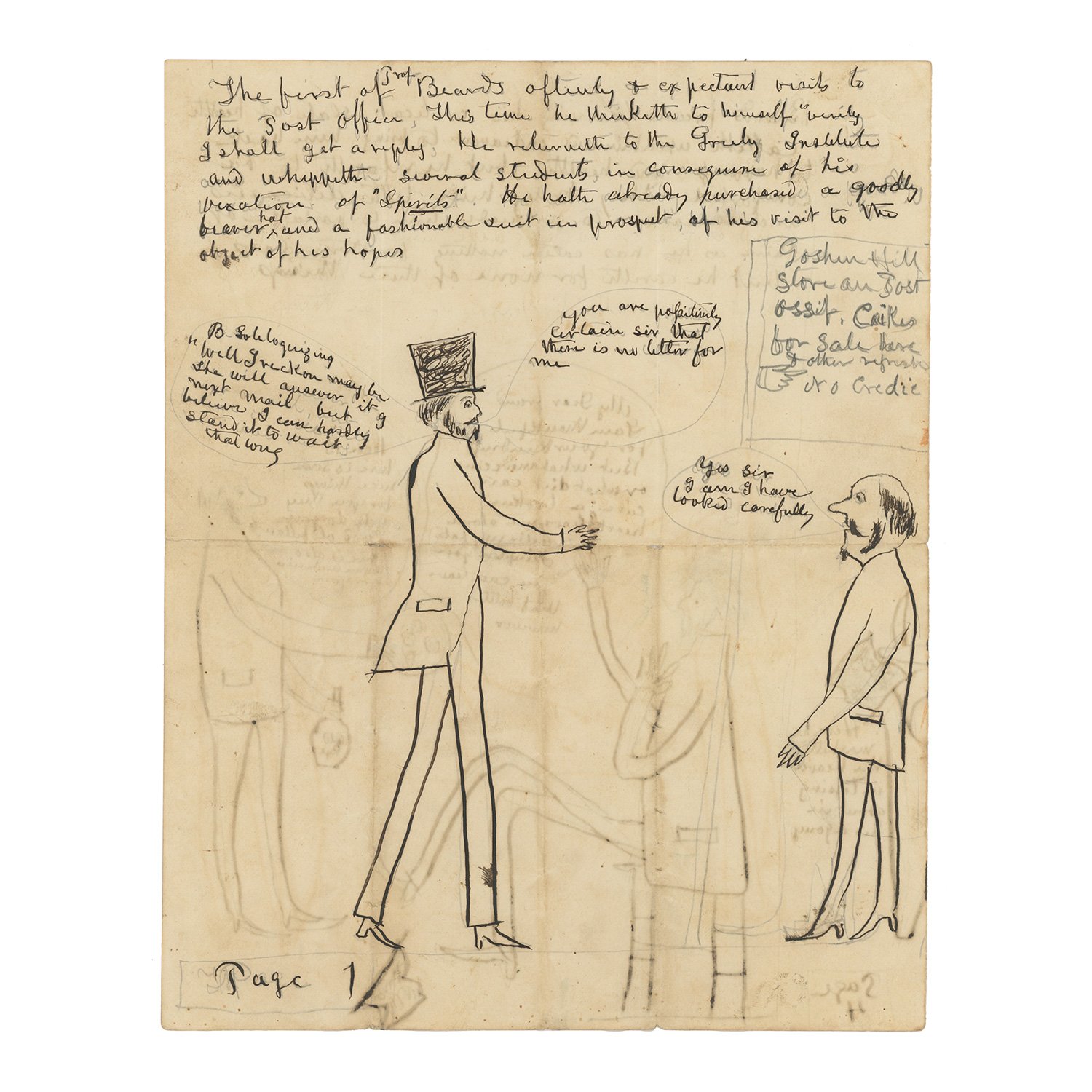
An extraordinary, highly localized, and incredibly rare piece of original Civil War-era Southern folk art and satire. This cohesive four-page piece consists of a completely handwritten and illustrated cartoon strip mocking the dramatic breakdown of a lovesick gentleman identified as “Mr. Beard.”
The piece originated in the family archive of Captain John S. Wilson, who served as the commander of Company D (“Chester Troop”) of the 1st South Carolina Cavalry.
The narrative parodies the overwrought, melodramatic literature popular during the 1860s, using a local backdrop familiar to Wilson and his contemporary circle in the Chester and Union District regions of South Carolina:
Page 1: Introduces a proudly dressed Mr. Beard making an “oftenly & expectant” visit to the “Goshon Hill [Goshen Hill] Store and Post Office,” confidently telling himself, “verily I shall get a reply.” Strutting in a fashionable suit and a pristine “goodly beaver hat,” Beard is devastated when the postmaster checks the mail cubbies and reveals there is no letter. Vexed in his “spirits,” Beard retreats to the “Gooly Institute” (likely a local academy or field school) where he aggressively takes out his frustration by “whipping several students.”
Page 2: Finds a visibly deteriorating Beard returning to the Goshen Hill office after repeated disappointments. He begins quoting biblical lamentations from the Book of Job (“verily a man is of few days and full of trouble”). When the postmaster notes how thin he has become and offers him refreshments, Beard dramatically refuses food but requests wine “for my Spirit's sake.”
Page 3: Captures the peak of Beard’s Victorian melodrama. He is illustrated wild-haired and disheveled, melting backward onto a parlor lounge and crying out, “Oh! That I never had seen her, then I had never been thus.”
Page 4: Delivers a cynical, brilliant punchline. Beard’s friends arrive at his bedside with delicacies, worried because he hasn’t eaten in three days. While Beard refuses the food, claiming no diet can cure a “broken heart,” he instantly drops the act to say, “You can leave that bottle however.” The bottle is clearly labeled “Old Rye.” The concluding text notes that during his theatrical thrashing, Beard has completely crushed and “mashed” his expensive new beaver top hat, which is seen crumpled on the floor beneath his feet.
The artwork features excellent, elongated pen-and-ink character caricatures reminiscent of period period block publications. The narrative relies heavily on a running double-entendre on the word “spirits” (alternating between emotional fortitude, ghosts, and alcohol), revealing that Beard’s devastating “illness” is nothing more than a dramatic excuse to avoid his duties and drink whiskey. Given its placement within the Wilson family papers, this was almost certainly drawn by a member of the Chester Troop, a local academic, or a relative to poke fun at a real-life mutual acquaintance’s pathetic romantic pining.
The piece was written upon four pages of a letter sheet measuring about 7 3/4” x 9 3/4”. The pages are separated at the center fold, but are otherwise in excellent condition. Creased at the original folds.
Item No. 7760572
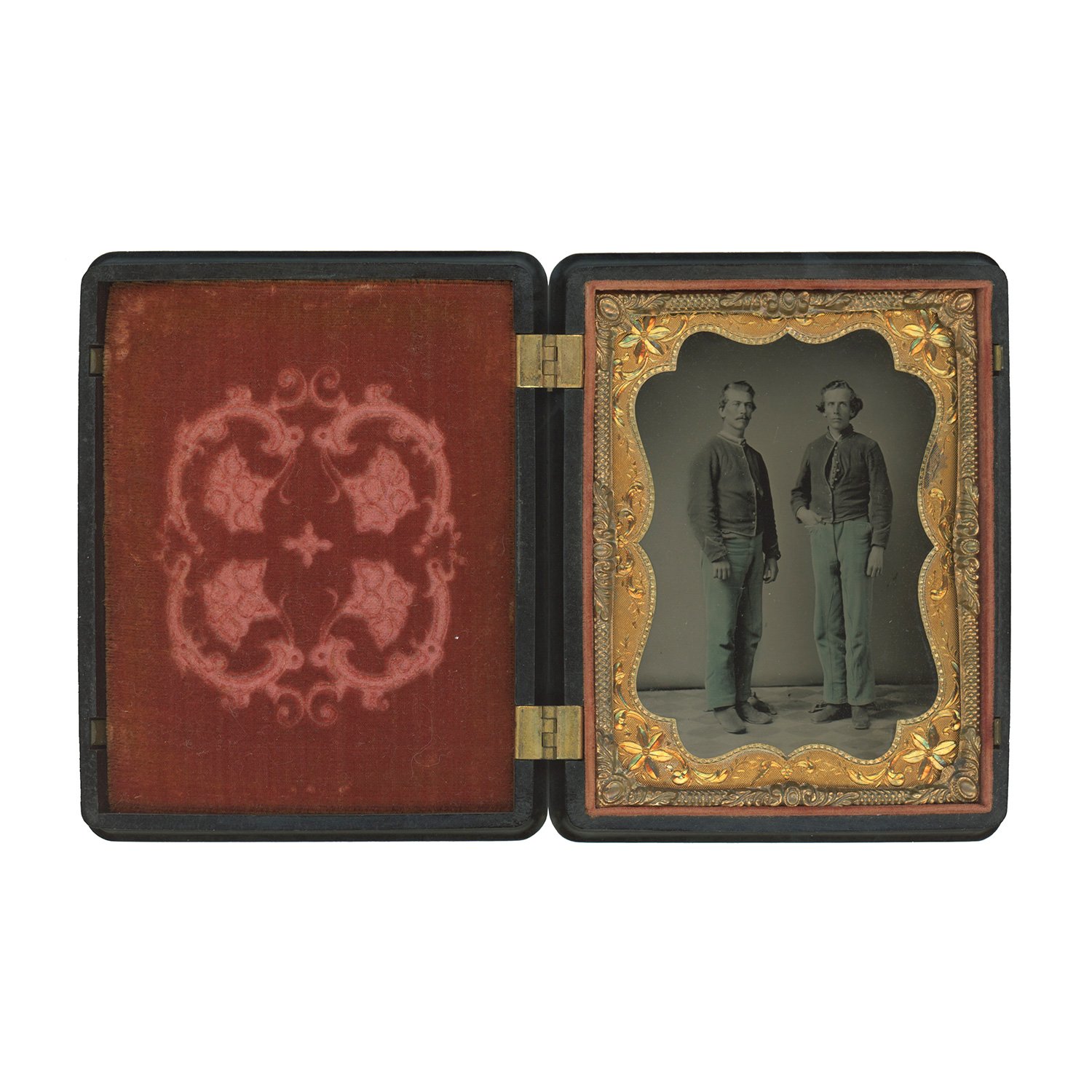
A quarter plate tintype photograph featuring a pair of Union soldiers. They could be cavalrymen or artillerymen, although they wear cavalry trousers (with nice blue tinting added by the photographer), and the untinted shade of the piping on their jackets suggests it could be yellow, further suggesting cavalry. The plate is in remarkably fine condition. The image is housed in a thermoplastic union case (Berg 1-34 Harvest Motif) in complete and nearly flawless shape.
Item No. 7968731
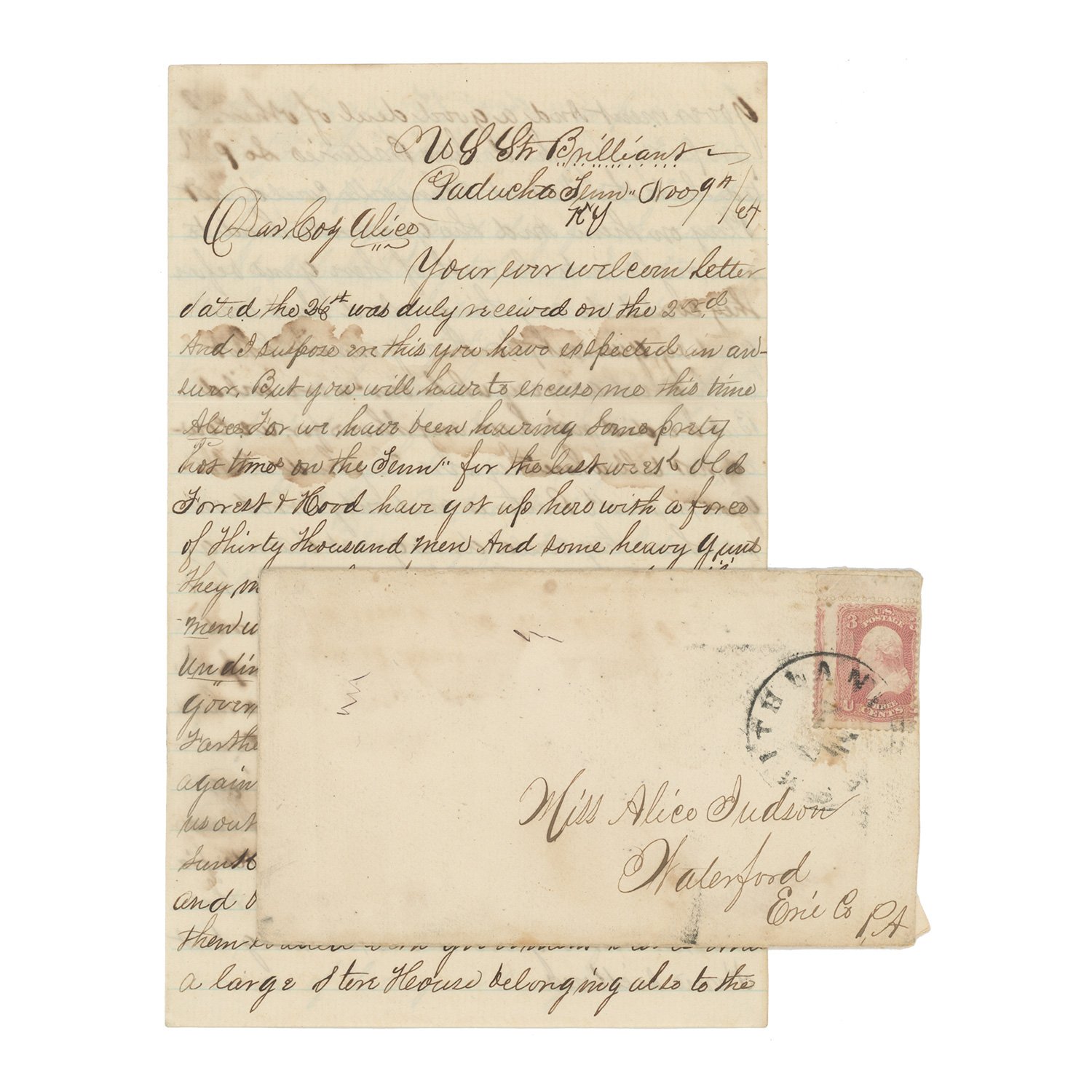
A sailor’s letter written November 9, 1864, by Timothy M. Judson aboard the stern-wheel tinclad gunboat U.S.S. Brilliant during Hood’s Tennessee Campaign. He remarks on the Battle of Johnsonville and the heavy Navy losses suffered there, when Confederate forces under Nathan Bedford Forrest destroyed Union gunboats, transports, and vast quantities of military supplies along the Tennessee River, inflicting one of the war's most costly logistical defeats on the Federal army. Judson also comments on Abraham Lincoln, George McClellan, and the 1864 presidential election.
Writing to his cousin Alice, Judson first apologizes for his late reply, “for we have been having some pretty hot times on the Tenn. [River] for the last week.” He continues:
Old Forrest & Hood have got up here with a force of thirty thousand men and some heavy guns. They made their first raid at old Fort Heindman, where they captured the gunboat Undine and two Steamers loaded with government Stores. They then made their way farther up the River to Johnsville, where they again Fought our whole Fleet and whipped us out, or at least we had to back water. They sunk three more of our Gunboats at this place and burnt some 6 or 7 Steam Boats, five of them loaded with government Stores, and a large Store House belonging also to the government, and a good deal of other property. They had their Batteries so planted that the Fort at Johnsville could not play on them, and the gunboats had to be run right into the teeth of their guns before they could do anything, and that was “goobye gunboat” for their gunners shot with great accuracy, while ours were wild. But we did not have any show for we could not tell where they were. They had all their guns in mask Batteries and only Fired on us where they could do us great damage. We were in some hot places, but did not know it till we began to retreat. By good luck, our Boat happened to be fetching up the rear, so we fared first rate, although we had to do some Fighting. Our Boat got a compliment for doing some good shooting, but I guess they was chance shots.
Judson also comments on the presidential election between Abraham Lincoln and George McClellan:
Well Alice, you wanted me to put in a vote for Honest old Abe. but our Election has gone up this time. We had to stand by our guns night and day for the last week. Alfred King told me Election day he thought we would all be Elected to go to the bottom of the River. I am sorry I could not have a chance to vote. But then it is just as well, for I am a Little Mac man anyhow. Our Boat is a regular Mac Boat. The Captain, Doctor, and most all of the Officers are Strong for Mac. I don’t think there is two dozen Abe men on the Boat.
The letter was written in ink on four pages of a bifolium letter sheet measuring about 5” x 8”. Light toning and ink staining. Includes the original stamped postal cover with Smithland, Kentucky, postmark addressed to Alice Judson in Waterford, Pennsylvania. The letter’s full transcript appears below.
U.S. Str. Brilliant
Paducah Ky Nov 9th / 64
Dear Coz Alice
Your ever welcome letter dated the 28th was duly received on the 2nd, and I suppose ere this you have expected an answer. But you will have to excuse me this time, Alice, for we have been having some pretty hot times on the Tenn. for the last week. Old Forrest & Hood have got up here with a force of thirty thousand men and some heavy guns. They made their first raid at old Fort Heindman, where they captured the gunboat Undine and two Steamers loaded with government Stores. They then made their way farther up the River to Johnsville, where they again Fought our whole Fleet and whipped us out, or at least we had to back water. They sunk three more of our Gunboats at this place and burnt some 6 or 7 Steam Boats, five of them loaded with government Stores, and a large Store House belonging also to the government, and a good deal of other property. They had their Batteries so planted that the Fort at Johnsville could not play on them, and the gunboats had to be run right into the teeth of their guns before they could do anything, and that was “goobye gunboat” for their gunners shot with great accuracy, while ours were wild. But we did not have any show for we could not tell where they were. They had all their guns in mask Batteries and only Fired on us where they could do us great damage. We were in some hot places, but did not know it till we began to retreat. By good luck, our Boat happened to be fetching up the rear, so we fared first rate, although we had to do some Fighting. Our Boat got a compliment for doing some good shooting, but I guess they was chance shots. I saw Vincent Wood the other day. He looks first rate, although he has been under the weather. But I guess it was nothing but Home sickness.
Well Alice, you wanted me to put in a vote for Honest old Abe. but our Election has gone up this time. We had to stand by our guns night and day for the last week. Alfred King told me Election day he thought we would all be Elected to go to the bottom of the River. I am sorry I could not have a chance to vote. But then it is just as well, for I am a Little Mac man anyhow. Our Boat is a regular Mac Boat. The Captain, Doctor, and most all of the Officers are Strong for Mac. I don’t think there is two dozen Abe men on the Boat. I would of like very much to of been at home to of seen Guy and Fin, for it has been a long time since I last seen them. I suppose the Boys had a great time at the convention, have they not? Well Ally, I will have to Knock off for this time. You must excuse this poor excuse of a letter, for it was wrote in haste and with one of the worsted Pens in the business. Now don’t fail to write soon one of those good long letters.
Oh Alice, you don’t know what a good letter you can write, so do please write again. You must excuse me for not writing before this. My Station keeps me pretty busy. Tell my folks I am well and give my love to all. Regards to Uncle Bill.
Yours Truly
T. M. Judson
Direct as before.
Item No. 1033228
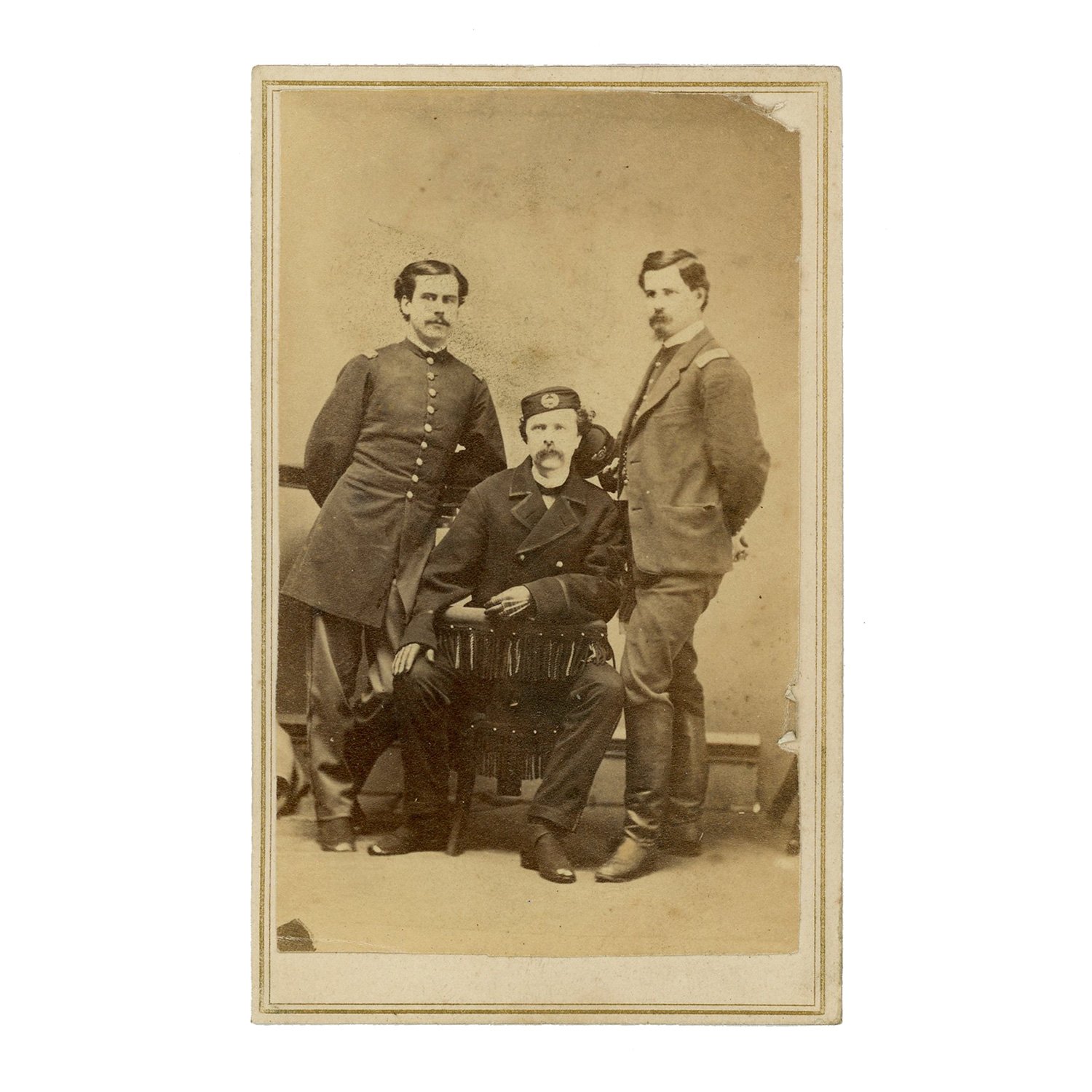
A group CDV portrait featuring three officers of the regular Army, photographed while serving at Fort Wayne in Detroit, Michigan, circa 1867. On the reverse is the imprint of Nason’s Gallery of Detroit. Seated at center is Bernard J. D. Irwin, the noted army surgeon, naturalist, and Medal of Honor recipient, and who assembled multiple CDV albums of Union and Confederate officers. This image came from Irwin’s family album. The officer standing at left is Thomas W. Lord, who enlisted in the 17th Maine as a sergeant in 1862 and was severely wounded in 1863 at the Battle of Chancellorsville. His left leg was amputated and he was discharged in September (he wears a prosthetic in the portrait). That December, however, after a second amputation on the same leg, Lord enlisted in the Veteran Reserve Corps, where he advanced to the rank of captain. He stayed in the Army after the war, serving until 1902. He is the older brother of George Edwin Lord, who was killed in 1876 at the Battle of the Little Big Horn while serving as assistant surgeon of George Armstrong Custer’s 7th U.S. Cavalry. The third officer is unidentified. The carte measures about 2 3/8” x 4”.
Item No. 9432618
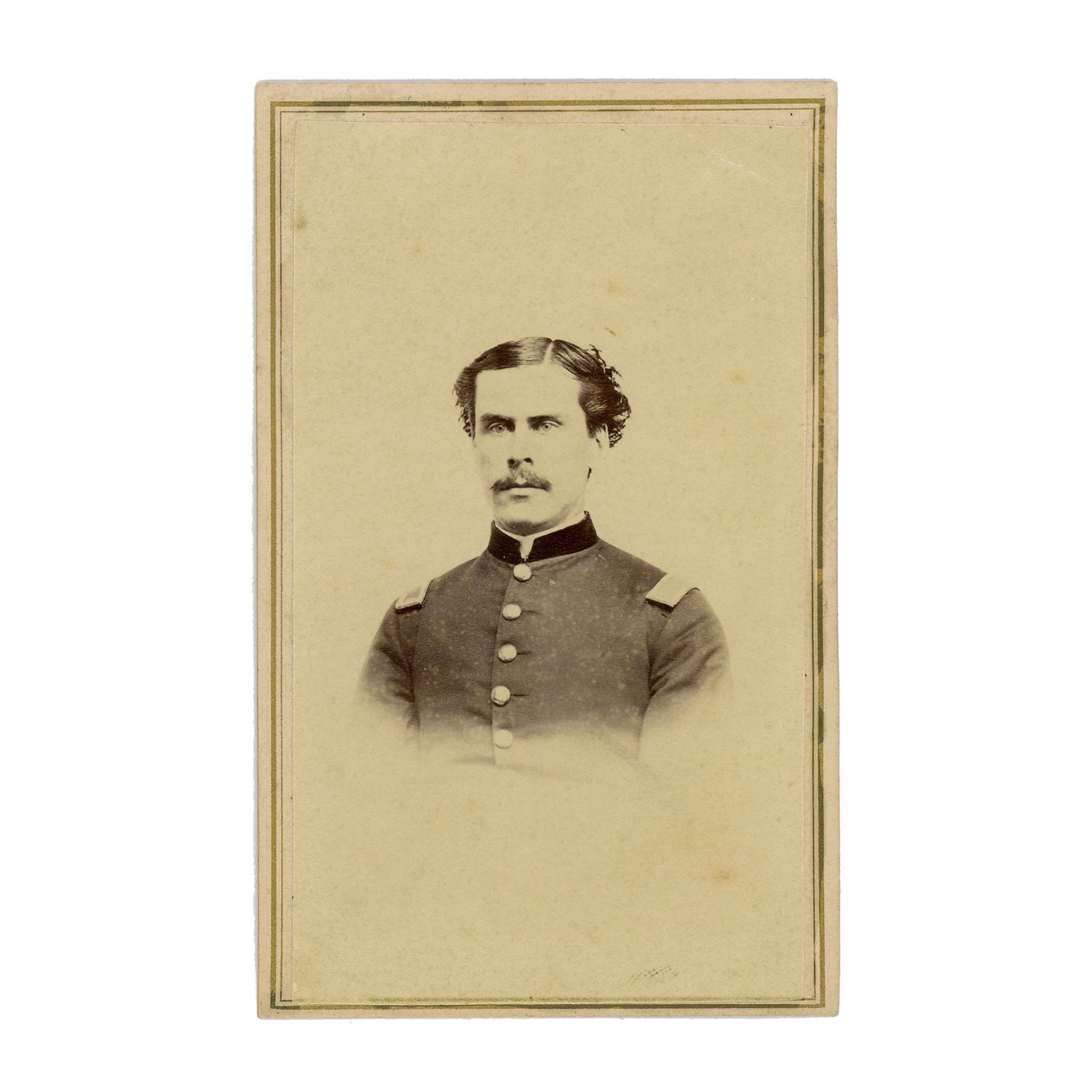
This signed CDV featuring Lieutenant Thomas W. Lord was likely made in 1866 or 1867 as his postwar service in the regular army was commencing. It is signed on the reverse, “Sincerely yours / Tho. Wm. Lord.” During the Civil War, Lord enlisted in the 17th Maine as a sergeant and was severely wounded in 1863 at the Battle of Chancellorsville. His left leg was amputated and he was discharged in September. That December, however, after a second amputation on the same leg, Lord enlisted in the Veteran Reserve Corps, where he advanced to the rank of captain. He stayed in the Army after the war, serving until 1902. The photograph was part of a family album assembled by Bernard John Dowling Irwin, the noted army surgeon, naturalist, and Medal of Honor recipient. Lord and Irwin served together at Fort Wayne in Detroit in 1867, which is when the image likely dates to. The carte measures about 2 3/8” x 4”.
Lord is the older brother ofGeorge Edwin Lord, who was killed in 1876 at the Battle of the Little Big Horn while serving as assistant surgeon of George Armstrong Custer’s 7th U.S. Cavalry.
Item No. 1271870
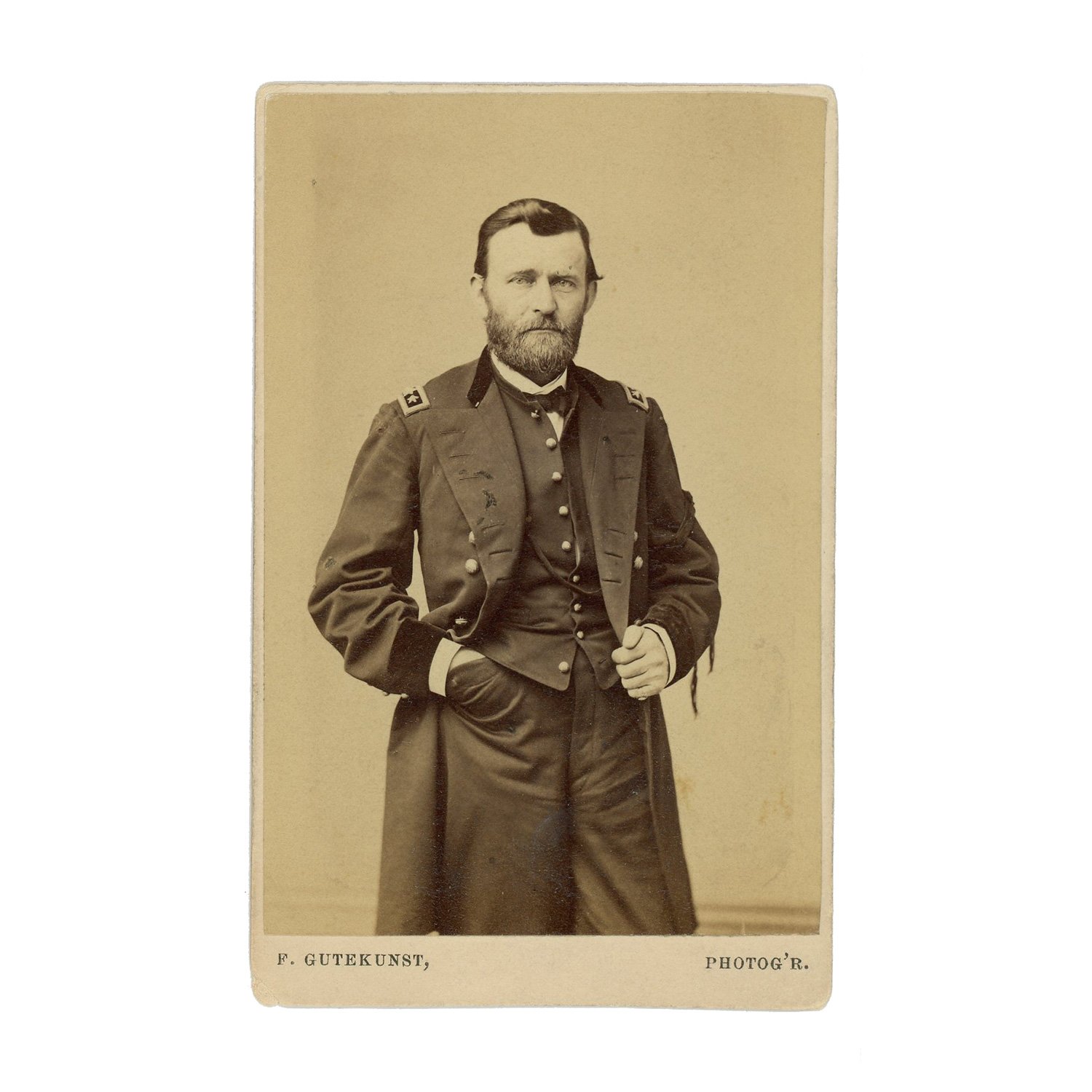
General Ulysses S. Grant appears in this CDV portrait by photographer Frederick Gutekunst in the spring of 1865. It is one of Grant’s more famous poses as the future president stands casually with a hand in his pant pocket and a mourning ribbon around his arm in memory of the recently slain Abraham Lincoln. The image was widely printed by distributors at the time. This carte, however, was produced by Gutekunst’s own Philadelphia studio and bears his imprint on both sides. It measures about 2 3/8” x 4”. Above the Gutekunst imprint on the reverse are the adhesive remnants where a revenue stamp was once attached.
Grant graduated from West Point in 1843 and served with distinction during the Mexican War before resigning from the army in 1854. Returning to military service at the outbreak of the Civil War, he rose rapidly through the ranks, securing key Union victories at Fort Donelson, Vicksburg, and Chattanooga. Appointed General-in-Chief of all Union armies in 1864, Grant directed the campaigns that led to the surrender of Confederate forces in 1865 and later served two terms as the 18th President of the United States.
Item No. 3807454
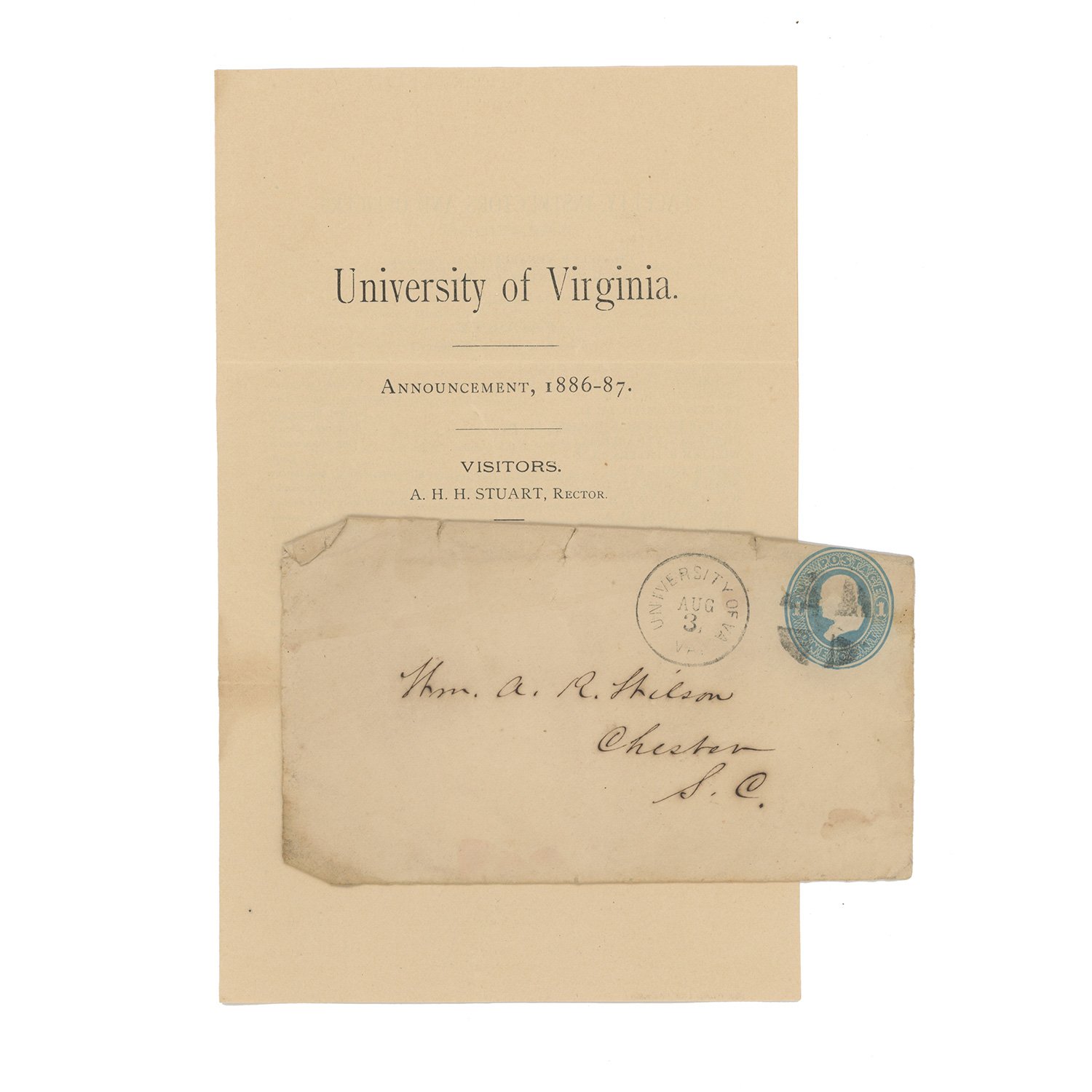
A 4-page promotional prospectus, approximately 5” x 8”, outlining the faculty, courses of instruction, student expenses, and facilities for the University of Virginia at Charlottesville. The list of listing of faculty and instructors includes a number of prominent figures:
Charles S. Venable (Chairman of the Faculty) served throughout the Civil War as one of General Robert E. Lee's closest aides-de-camp, eventually reaching the rank of lieutenant colonel. After the war he returned to UVA, became chairman of the faculty, helped establish the McCormick Observatory, and was one of the university's most influential professors.
A. H. H. Stuart (Rector) was an important Virginia statesman. Before the Civil War he served as U.S. Secretary of the Interior under President Millard Fillmore and was one of the last surviving members of Fillmore's cabinet.
John B. Minor, professor of law, was one of the most famous law professors in the South. His Institutes of Common and Statute Law remained a standard legal text for decades, and he trained generations of Virginia attorneys.
James L. Cabell, professor of physiology and surgery, was among the nation's leading physicians. He became an important advocate for modern public health and helped lay the foundation for what became the U.S. Public Health Service.
Maximilian Schele De Vere was a well-known philologist and linguist whose writings on language and immigration were widely read.
George Frederick Holmes was a noted historian and political economist who taught before the war at the University of Mississippi and later became one of UVA's leading scholars.
Holmes Conrad had served as Solicitor of the U.S. Treasury before the Civil War and later became a respected Virginia attorney.
William H. Payne was a former Confederate cavalry brigadier general and later served in Virginia politics.
John A. Walker was a former Confederate brigadier general and later a justice of the Virginia Supreme Court.
Edward C. Venable was a prominent Virginia attorney and civic leader in Petersburg.
Among the most interesting portions of the document is the portion that discusses student expenses, with tuition being just $75 per year and “dormitory rent” just $15.
The document is in excellent condition with original folds. Also includes the original postal cover addressed to William A. R. Wilson of Chester, South Carolina, who had attended UVA in the 1870s.

Wanted!
Recruitment Broadsides, Meeting Notices, Handbills, and Other Printed Advertising of the Civil War Years

The Bernard J. D. Irwin Collection of Union and Confederate General Officer Portraits
Read about the incredible CDV collection compiled by the Medal of Honor’s earliest recipient.
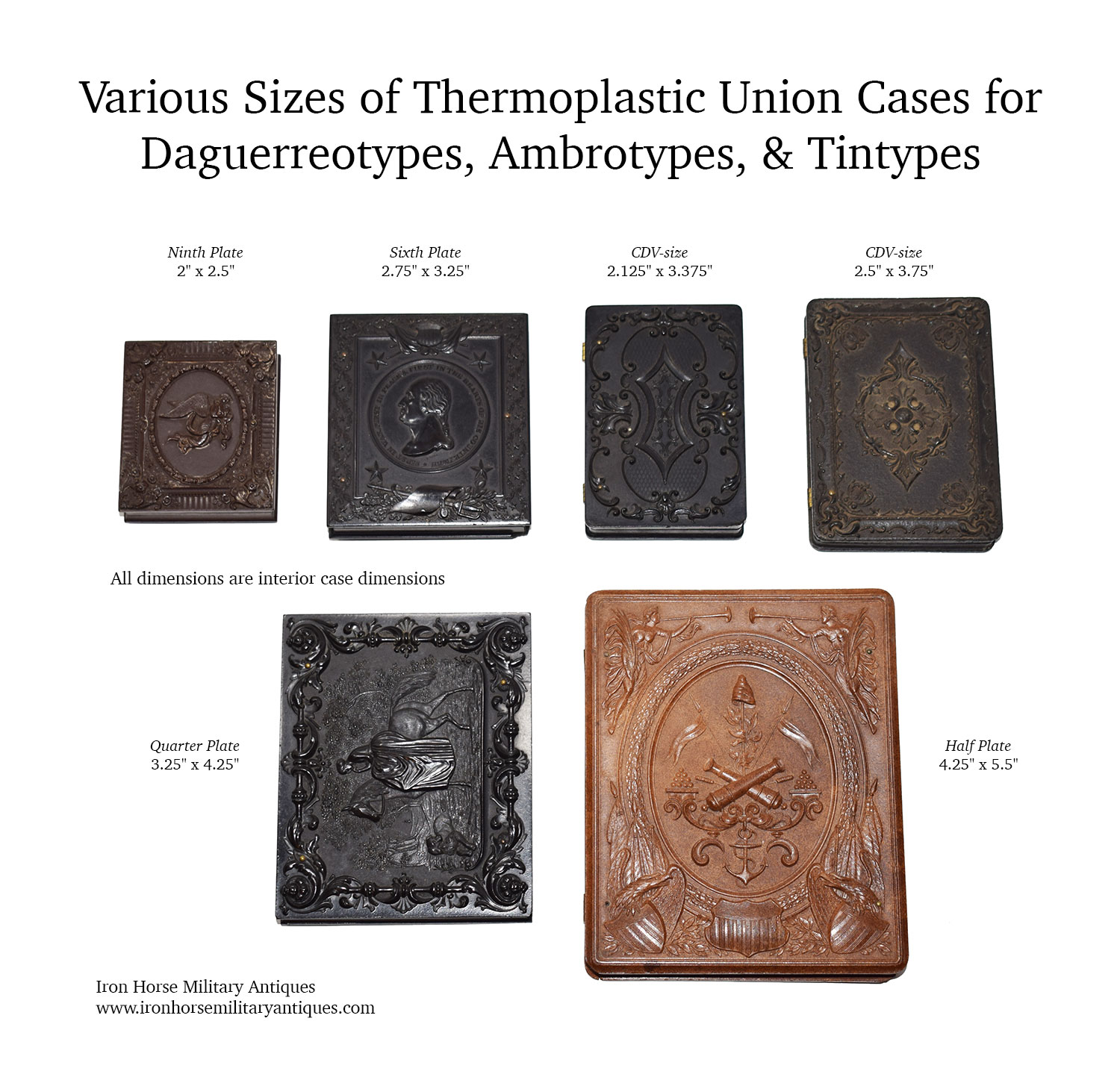
Understanding the various sizes of nineteenth-century photographic images and their union cases.
A union case is a great way to protect and display an antique image. The most commonly seen sizes are, from smallest to largest, sixteenth plate (not pictured), ninth plate, sixth plate, quarter plate, half plate, and full plate (not pictured). There are also several “CDV-size” styles, two of which are shown here. Union cases are made from a variety of materials, the most common being thermoplastic (as shown), paper, and leather.
Click on the image to the left to see a larger version.

Item No. 9731866
CDV of General William Tecumseh Sherman seated at a small table, writing as he looks toward the camera. The image dates to circa 1865 when Sherman still held the rank of major general. It was produced in the Chicago studio of photographer Samuel M. Fassett, whose imprint is on the reverse. The carte measures about 2 3/8” x 4”.
Sherman was one of the Union Army's most prominent commanders, leading the campaigns for Atlanta, the March to the Sea, and the Carolinas in the final year of the Civil War. He succeeded Ulysses S. Grant as Commanding General of the U.S. Army in 1869 and remained in that position until his retirement in 1884.