
1864 Letter by General Robert C. Schenck, Lamenting the Dissolution of his Military Staff After his 1863 Return to Congress, Including Conversation with Secretary of War Edwin M. Stanton
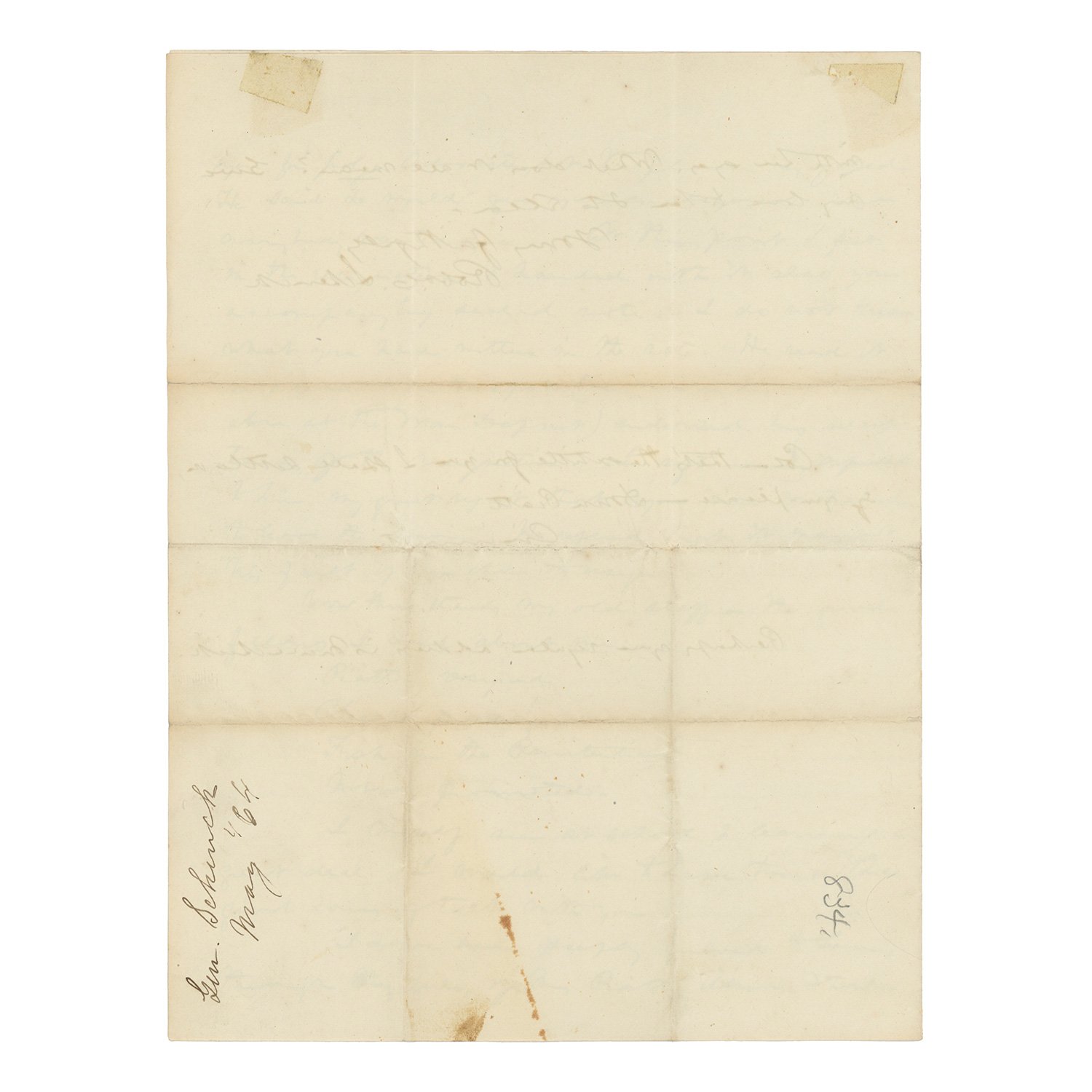
1864 Letter by General Robert C. Schenck, Lamenting the Dissolution of his Military Staff After his 1863 Return to Congress, Including Conversation with Secretary of War Edwin M. Stanton
Item No. 5160348
An 1864 autograph letter signed by Congressman Robert C. Schenck of Ohio, in which the recently retired Union general writes to his military chief-of-staff, Lieutenant Colonel Donn Piatt, regarding Secretary of War Edwin M. Stanton’s reaction to Piatt’s resignation. Schenck also considers the post-military fate of his former headquarters staff following his 1863 return to Congress.
Schenck explains that Piatt’s resignation from the Army had been formally presented to and accepted by Secretary of War Edwin M. Stanton, after Schenck determined that pending legislation to create a Bureau of Military Justice would not result in Piatt receiving an appointment as assistant judge advocate general. Schenck recounts his direct conversations with Stanton regarding Piatt’s prospects:
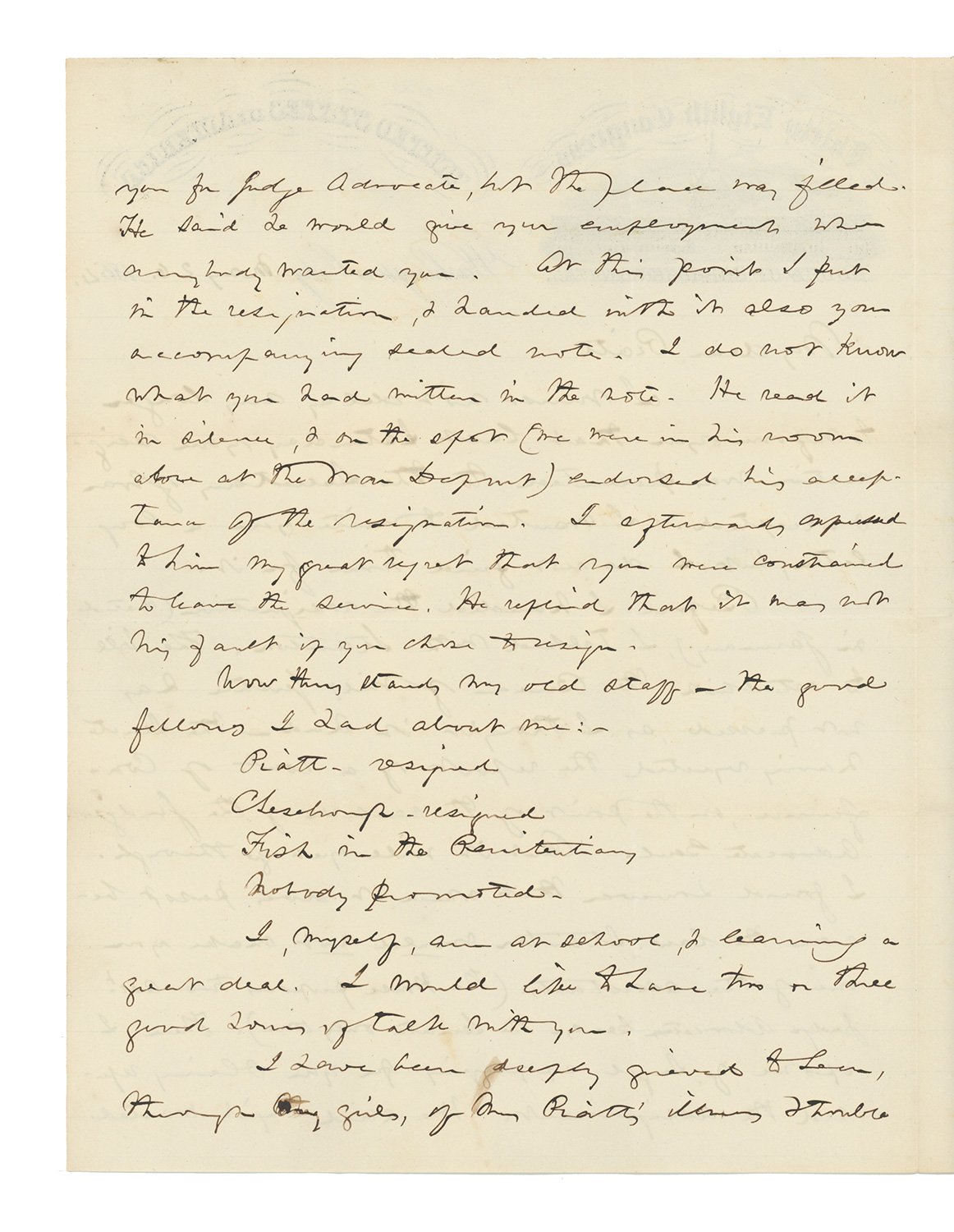
At this point, I put in the resignation, & handed with it also your accompanying sealed note. I do not know what you had written in the note. He read it in silence, & on the spot (we were in his room above at the War Depmt.) endorsed his acceptance of the resignation. I afterwards expressed to him my great regret that you were constrained to leave the service. He replied that it was not his fault if you chose to resign.
In a striking summary of the dissolution of his former staff, Schenck notes that Piatt and Lieutenant Colonel William H. Chesebrough had resigned, Colonel William S. Fish was “in the Penitentiary,” and none had been promoted, while Schenck himself was now “at school,” learning the ways of Congress. (Fish had been found guilty by court martial for corruption during his time as provost marshal in Baltimore, when Schenck commanded the volatile Middle Department. He would be pardoned by President Lincoln in February 1865.)
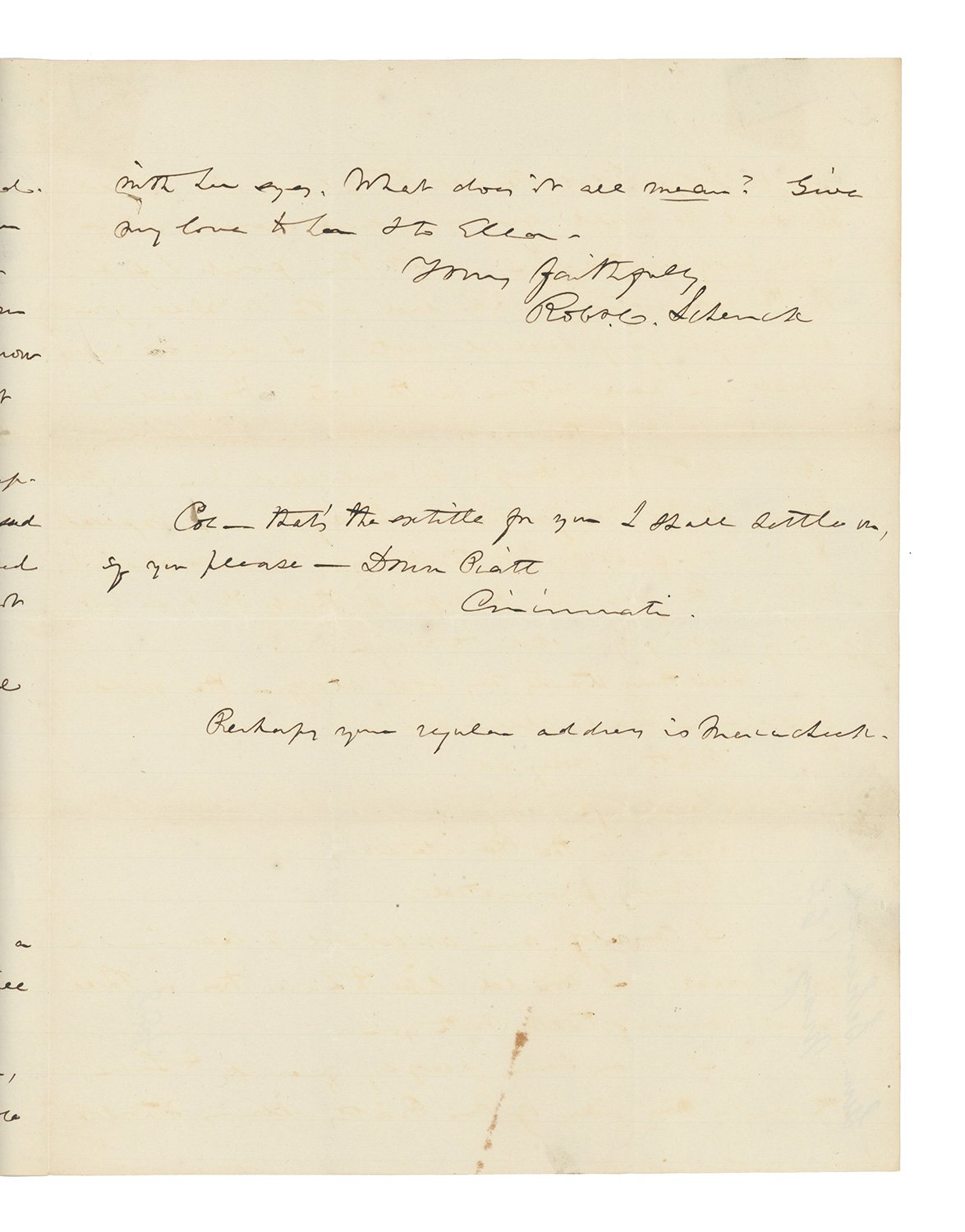
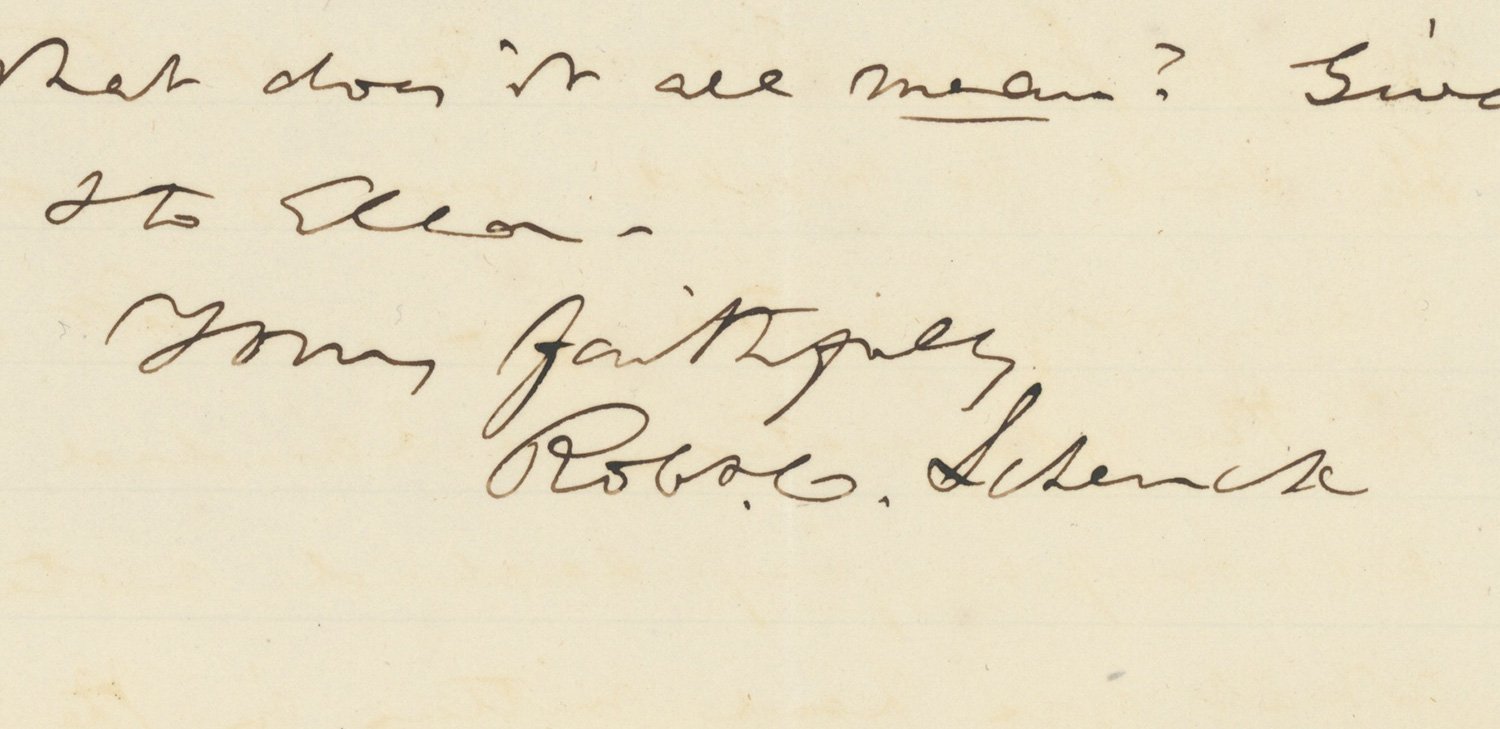
Schenck closes the letter inquiring about the ill health of of Piatt’s wife, before signing “Robt. C. Schenck.”
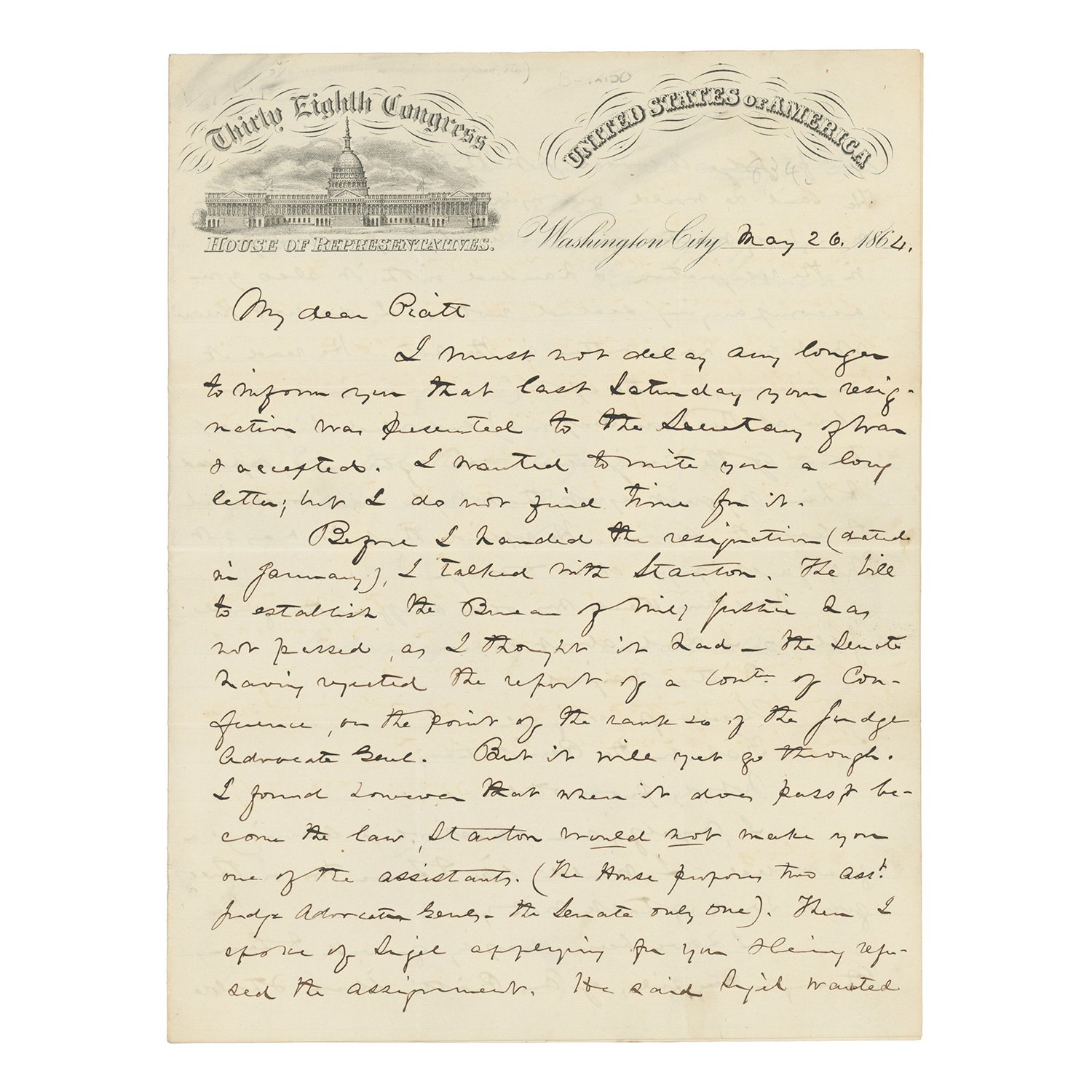
The letter was written upon three pages of a four-page letter sheet measuring 7 3/4” x 10 1/4”. The letter sheet bears a decorative heading of the Thirty-Eighth Congress and the House of Representatives. Briefly docketed on the fourth page. Creased at the original folds. The full transcript appears below.
Born in Franklin, Ohio, he graduated from Miami University, became a prominent lawyer in Dayton, and was elected repeatedly to the U.S. House of Representatives as a Whig before serving as minister to Brazil. At the outbreak of the Civil War he accepted a commission as a brigadier general of volunteers in May 1861, leading a brigade at First Bull Run and later commanding a division in the Shenandoah Valley Campaign and at Second Bull Run, where he was seriously wounded in the arm. Promoted to major general later that year, he held key administrative posts including command of the Middle Department and the defenses of Washington and Baltimore. In 1863 he resigned his volunteer commission to return to Congress, taking the seat previously held by the exiled Copperhead Clement L. Vallandigham. After the war Schenck continued to serve in the House of Representatives and later as U.S. Minister to Great Britain.
United States of America
Thirty Eighth Congress
House of Representatives
Washington City May 26, 1864.
My dear Piatt
I must not delay any longer to inform you that, last Saturday, your resignation was presented to the Secretary of War & accepted. I wanted to write you a long letter; but I do not find time for it.
Before I handed the resignation (dated six January), I talked with Stanton. The bill to establish the Bureau of Mil. Justice has not passed, as I thought it had—the Senate having requested the report of a comt. of conference on the point of the rank &c. of the Judge Advocate Genl. But it will yet go through. I found, however, that when it does pass & become the law, Stanton would not make you one of the assistants. (The House proposes two asst. Judge Advocate Genls. The Senate only one.) Then I spoke of Sigel applying for you & being refused the assignment. He said Sigel wanted you for Judge Advocate, but the place was filled. He said he would give you employment when anybody wanted you. At this point, I put in the resignation, & handed with it also your accompanying sealed note. I do not know what you had written in the note. He read it in silence, & on the spot (we were in his room above at the War Depmt.) endorsed his acceptance of the resignation. I afterwards expressed to him my great regret that you were constrained to leave the service. He replied that it was not his fault if you chose to resign.
Now thus stands my old staff, the good fellows I had about me:
Piatt, resigned
Chesebrough, resigned
Fish, in the Penitentiary
Nobody promoted
I, myself, am at school, & learning a great deal. I would like to have two or three good hours of talk with you.
I have been deeply grieved to hear, through my girls, of Mrs. Piatt’s illness & trouble with her eyes. What does it all mean? Give my love to her & to Ellen.
Yours faithfully
Robt. C. Schenck
Col.—that’s the ex-title for you I shall settle on, if you please—
Donn Piatt
Cincinnati
Perhaps your regular address is Massachusetts.