
Group of Home Front Letters by John Douglas to Captain William A. Walker, 1st South Carolina Cavalry — Considers Chaplaincy of Regiment — Deaths of South Carolina Men at Battle of Second Manassas
Group of Home Front Letters by John Douglas to Captain William A. Walker, 1st South Carolina Cavalry — Considers Chaplaincy of Regiment — Deaths of South Carolina Men at Battle of Second Manassas
Item No. 4229054
A group of four home front letters written by John Douglas of Chester, South Carolina, to his nephew Captain William Alexander Walker of the 1st South Carolina Cavalry in the late summer of 1862. In them, Douglass discusses his role as a rural pastor, his interest in joining Walker’s regiment as the unit’s chaplain, and the many local men killed and wounded at the Battle of Second Manassas.
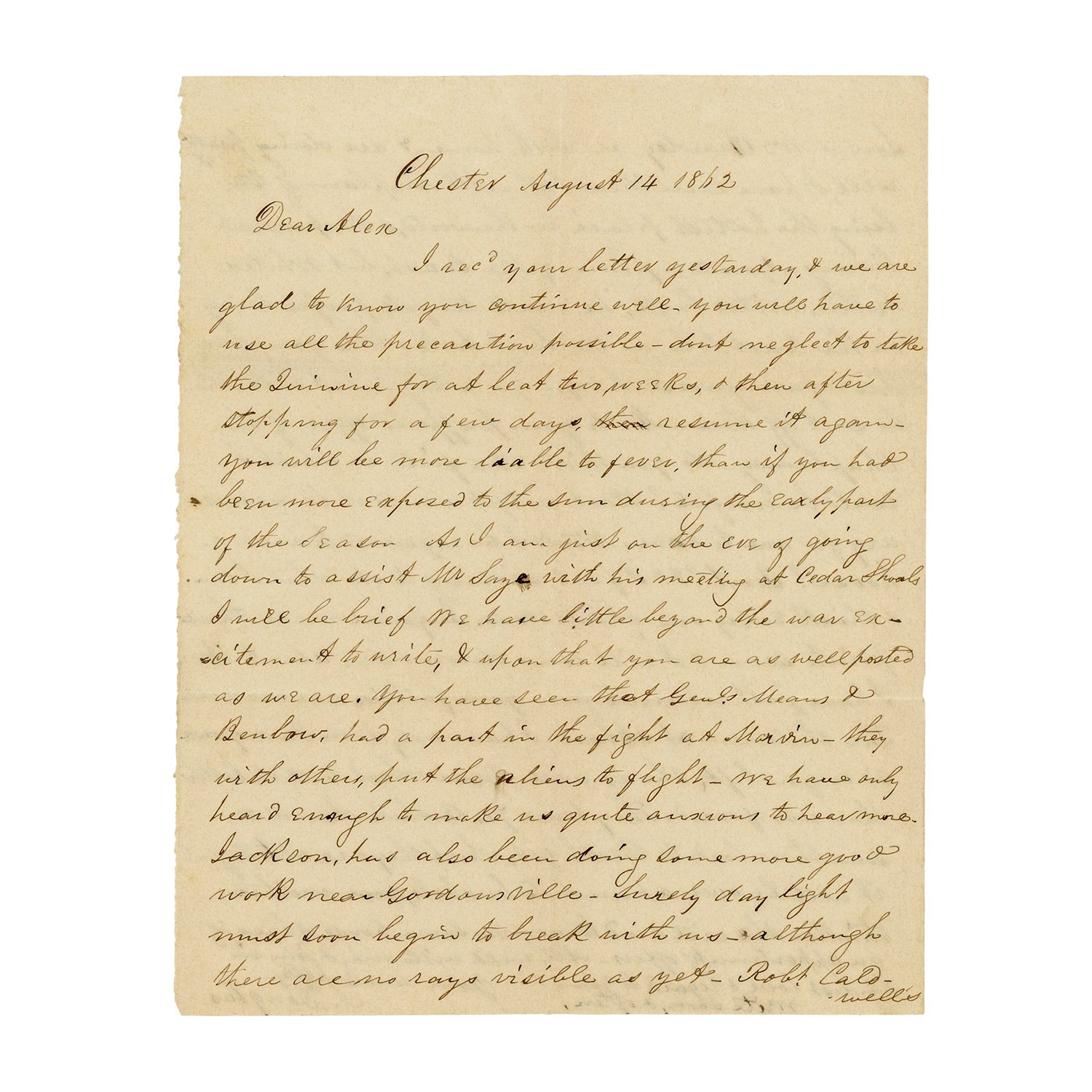
Writing the first letter from Chester on August 14, 1862, Douglas instructs Walker, who had been recovering from illness, “don’t neglect to take the Quinine for at least two weeks, & then after stopping for a few days, resume it again.” He then discusses the roles of local men in recent actions in Virginia, specifically the August 6 occupation of the Malvern Hill battlefield. “You have seen that Genls. Means & Benbow [likely referring to the 17th and 23rd South Carolina] had a part in the fight at Marvin [sic]. They, with others, put the aliens to flight. We have only heard enough to make us quite anxious to hear more.” He also possibly references “Stonewall” Jackson’s August 9 victory at the Battle of Cedar Mountain, writing, “Jackson has also been doing some more good work near Gordonsville.”
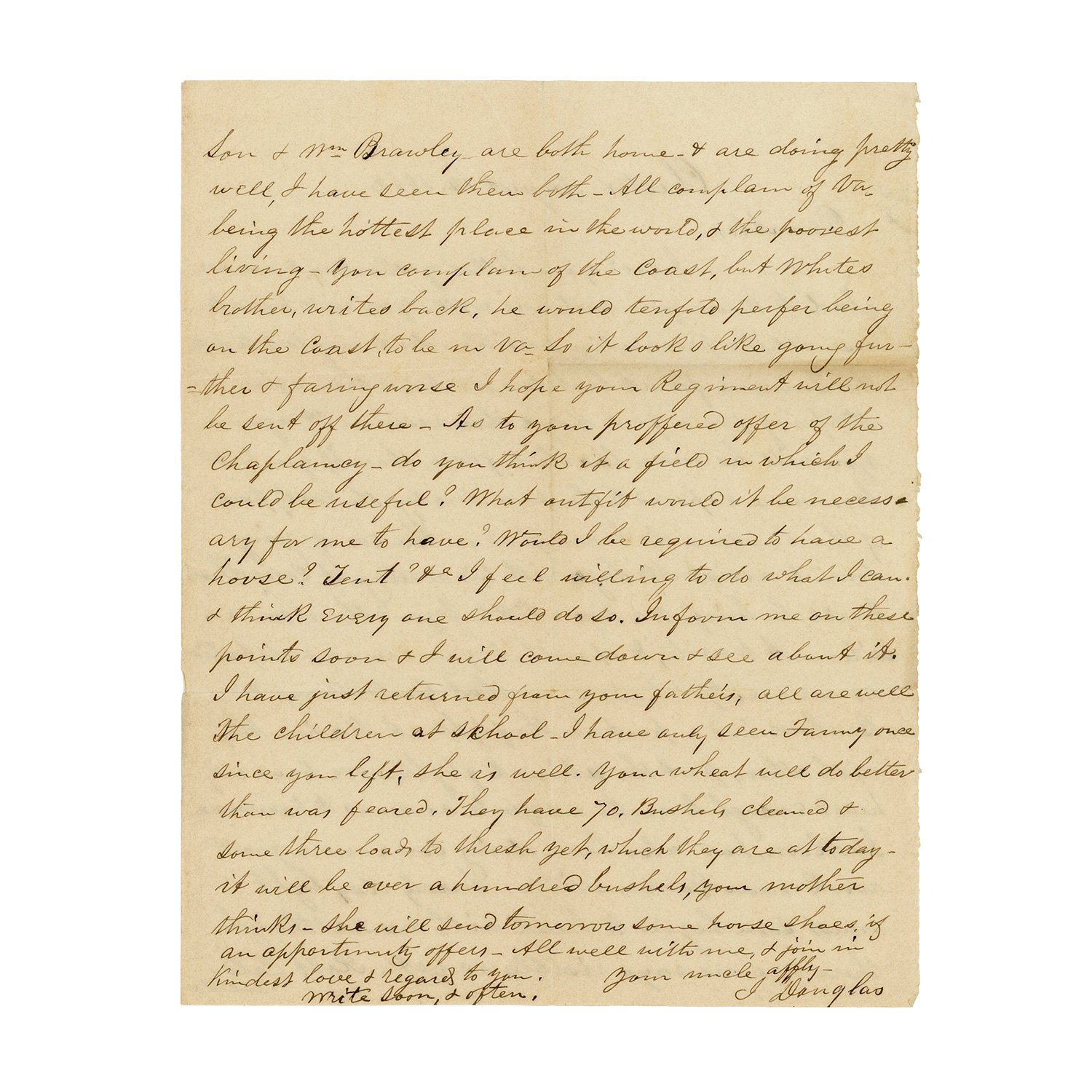
Douglas then discusses the chaplaincy of Walker’s regiment, which had evidently been offered to him:
As to your proffered offer of the Chaplaincy, do you think it a field in which I could be useful? What outfit would it be necessary for me to have? Would I be required to have a horse? Tent? &c. I feel willing to do what I can & think everyone should do so. Inform me on these points soon & I will come down & see about it.
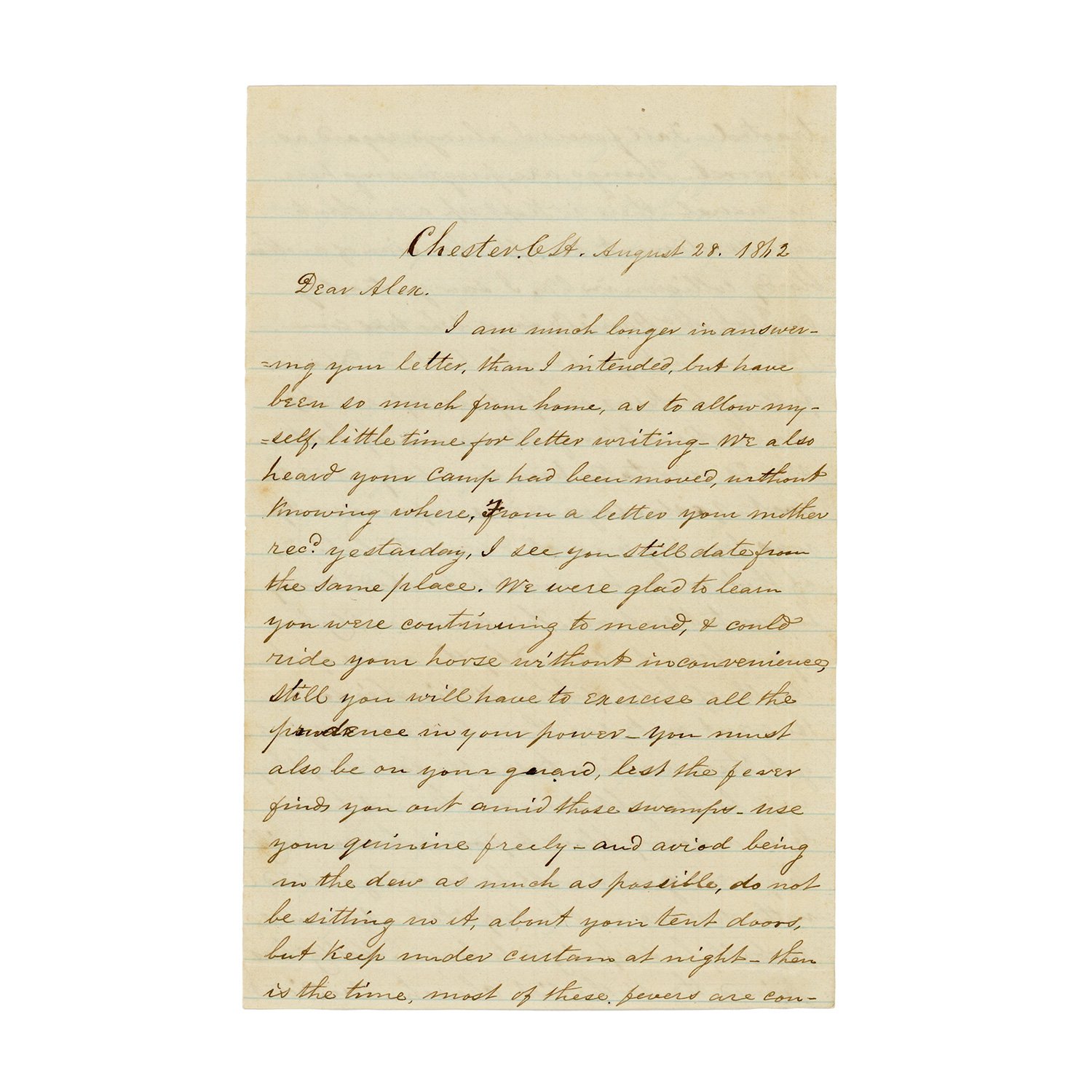
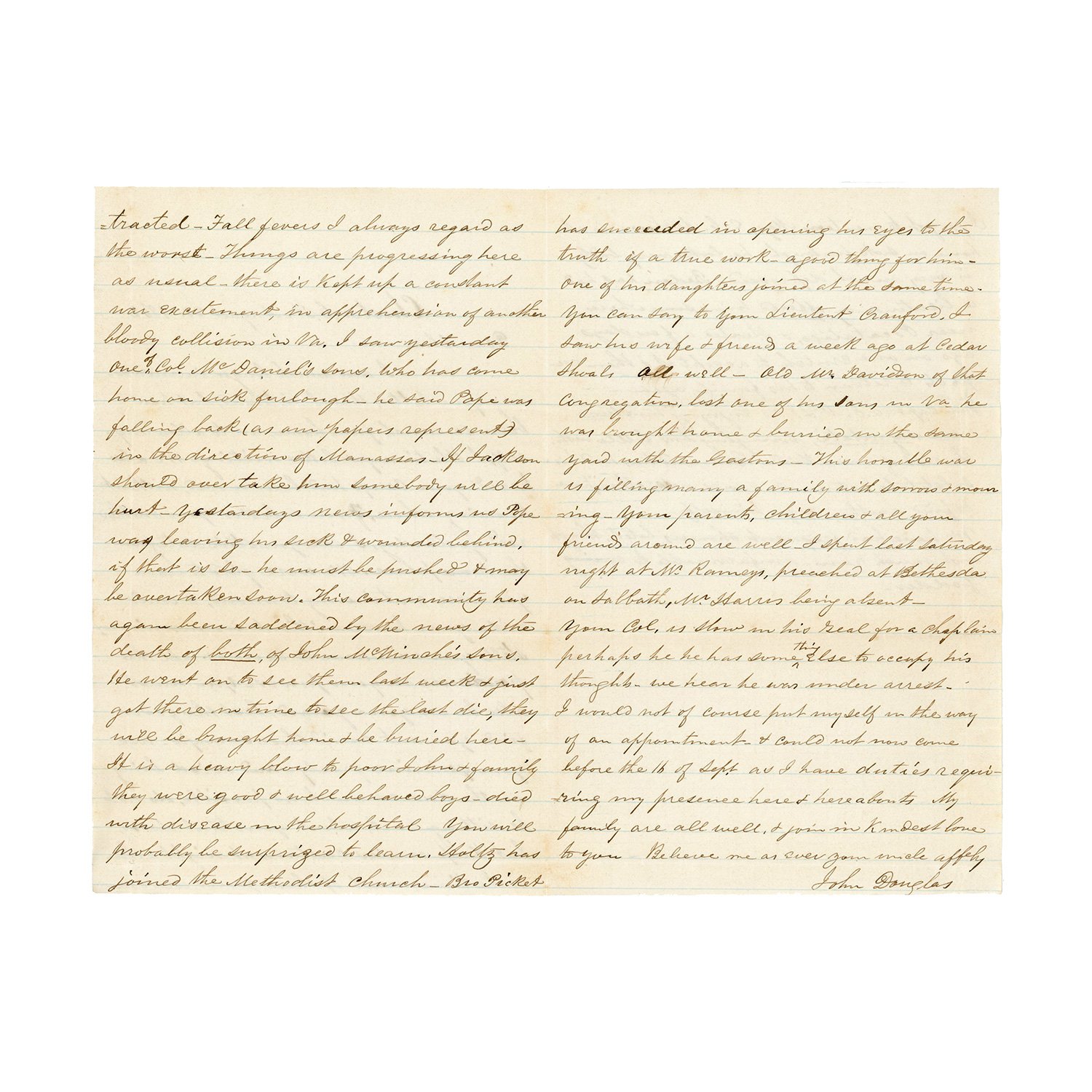
The next letter was written two weeks later, on August 28. Douglas offers additional advice for Walker’s recovery, writing, “you will have to exercise all the prudence in your power. You must also be on your guard, lest the fever finds you out amid those swamps. Use your quinine freely, and avoid being in the dew as much as possible.” He then discusses the “constant war excitement in apprehension of another bloody collision” up in Virginia (unbeknownst to Douglas, the Second Battle of Manassas had begun that day). He continues:
I saw yesterday one of Col. McDaniel’s sons, who has come home on sick furlough. He said Pope was falling back (as our papers represent) in the direction of Manassas. If Jackson should overtake him, somebody will be hurt. Yesterday’s news informs us Pope was leaving his sick & wounded behind. If that is so, he must be pushed & may be overtaken soon.
Douglas then turns his attention to the deaths of more local men, this time from the McNinch family. They likely belonged to the 6th or 23rd South Carolina, each of which included several men by that name. Douglas writes:
This community has again been saddened by the news of the death of both of John McNinch’s sons. He went on to see them last week & just got there in time to see the last die. They will be brought home & be buried here. It is a heavy blow to poor John & family. They were good & well behaved boys. Died with disease in the hospital…. This horrible war is filling many a family with sorrow & mourning.
Regarding the chaplaincy of the 1st South Carolina Cavalry, he writes, “Your Col. is slow in his zeal for a chaplain. Perhaps he has something else to occupy his thoughts. We hear he was under arrest,” adding, “I would not, of course, put myself in the way of an appointment & could not now come before the 16 of Sept., as I have duties requiring my presence here & hereabouts.”
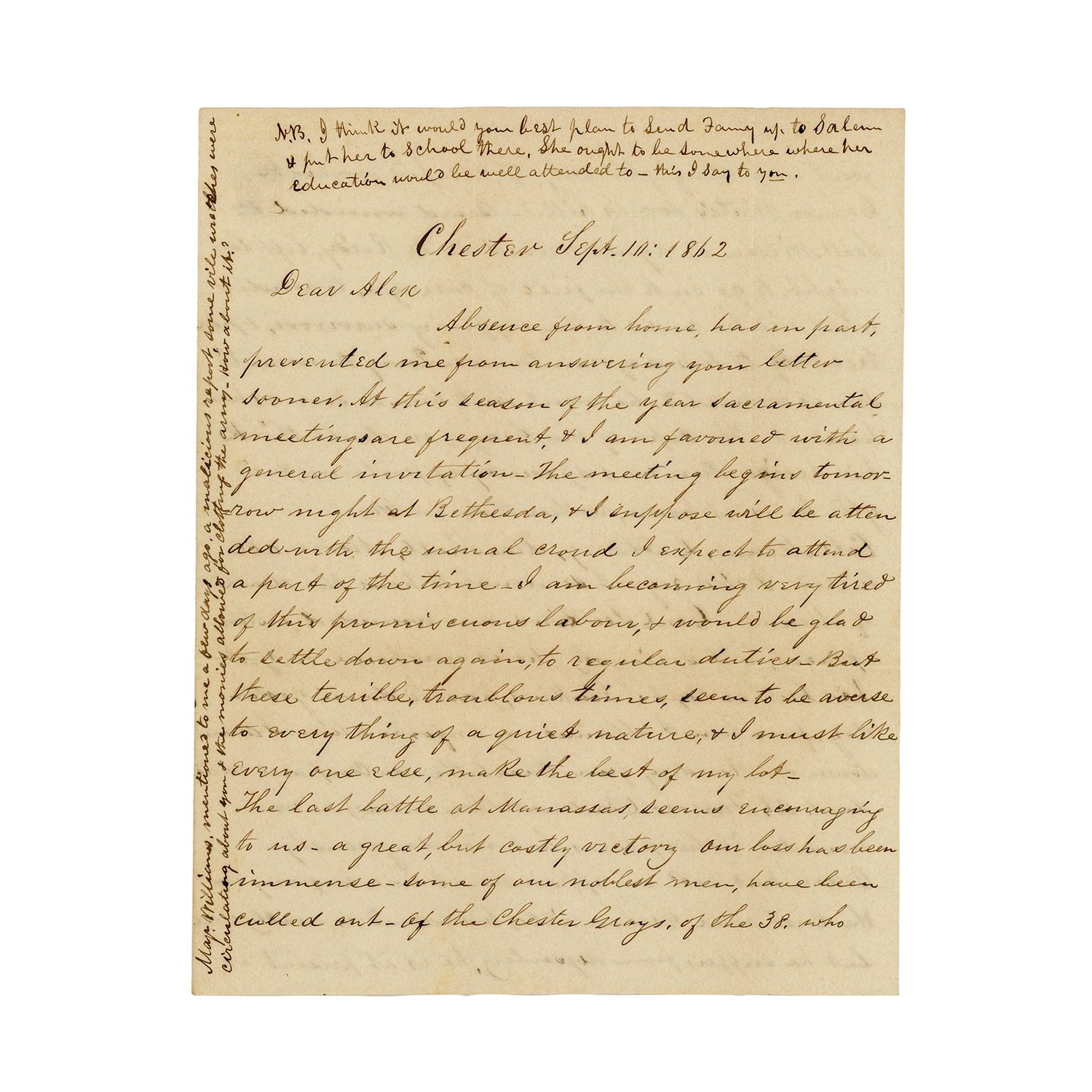
Douglas opens his third letter, written on September 10, by describing his clerical duties:
Absence from home has, in part, prevented me from answering your letter sooner. At this season of the year, sacramental meetings are frequent & I am favored with a general invitation. The meeting begins tomorrow night at Bethesda, & I suppose will be attended with the usual crowd. I expect to attend a part of the time. I am becoming very tired of their promiscuous labour, & would be glad to settle down again to regular duties. But these terrible, troublous times, seem to be averse to everything of a quiet nature, & I must, like everyone else, make the best of my lot.
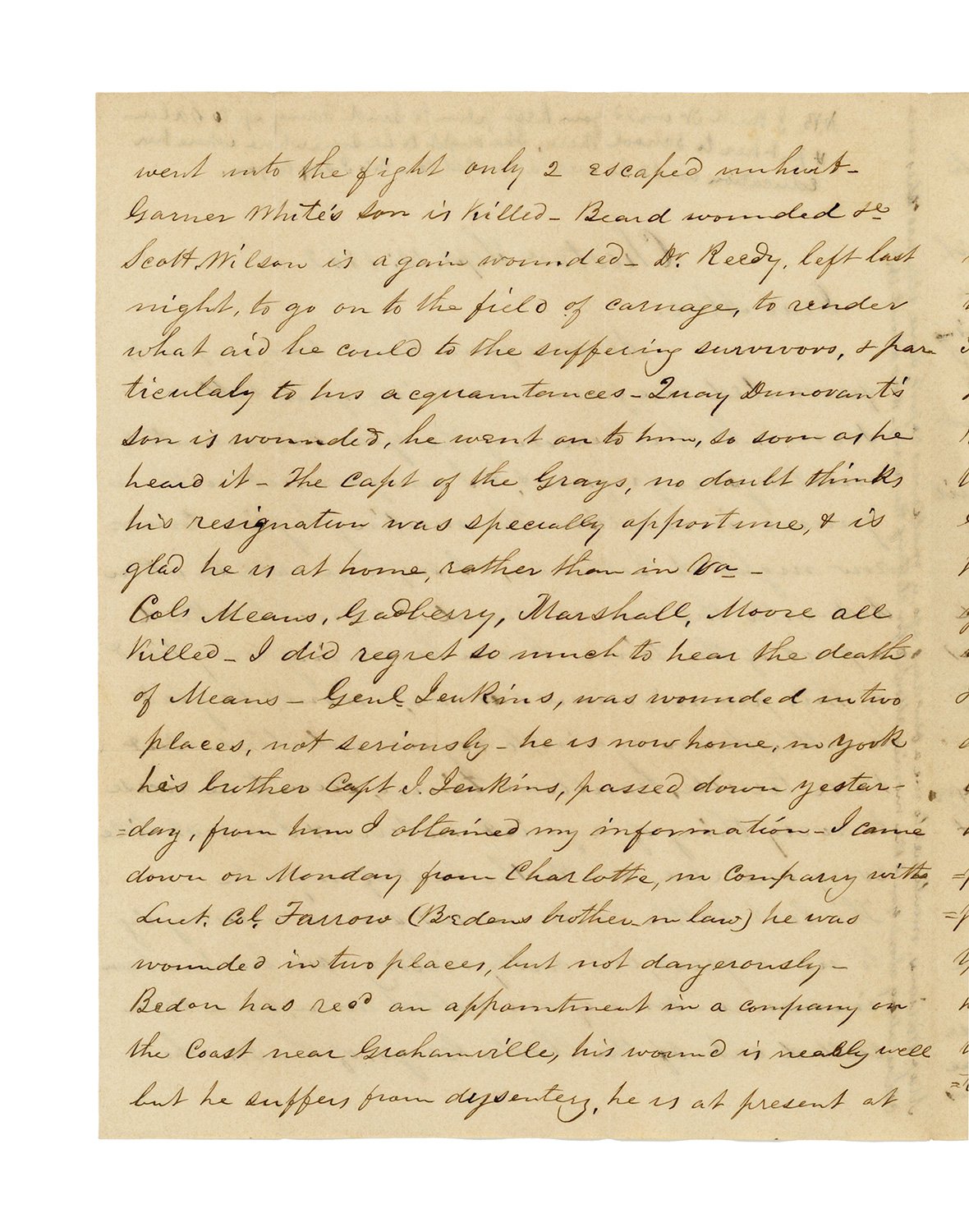
The letter is otherwise packed with news about the fighting at Second Manassas and the casualties suffered by local companies serving in the 6th, 17th, and 23rd Regiments:
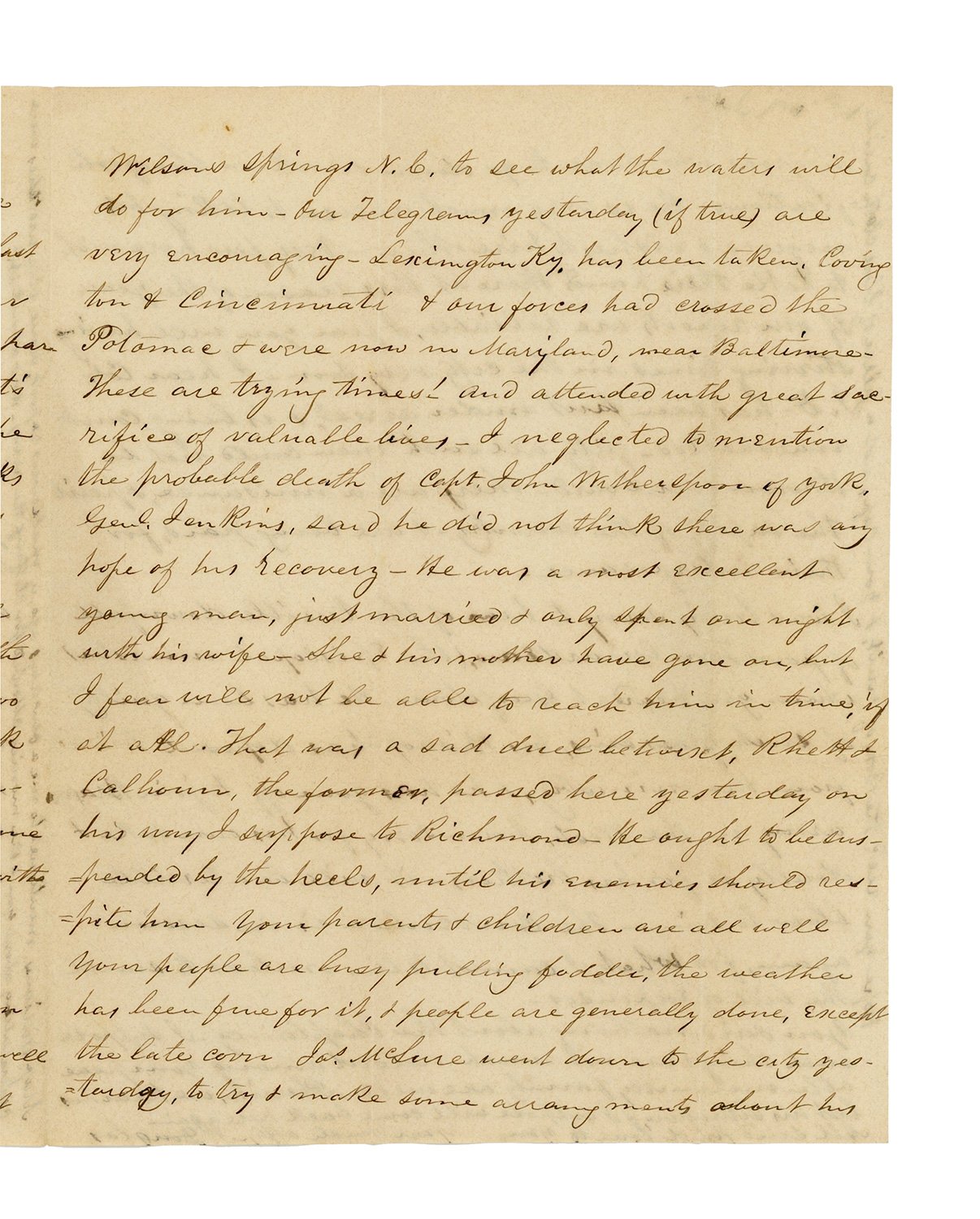
The last battle at Manassas seems encouraging to us. A great but costly victory. Our loss has been immense. Some of our noblest men have been called out. Of the Chester Grays [Co. F, 23rd Regt.], of the 38 who went into the fight, only 2 escaped unhurt. Garner White’s son is killed. Beard wounded &c. Scott Wilson [6th Regt.] is again wounded. Dr. Reedy left last night to go onto the field of carnage, to render what aid he could to the suffering survivors, & particularly to his acquaintances. Troy Donuvant’s son is wounded. He went on to him, so soon as he heard it. The Capt. of the Grays, no doubt, thinks his resignation was specially opportune, & is glad he is at home rather than in Va…. I neglected to mention the probable death of Capt. John Witherspoon of York. Genl. [Micah] Jenkins said he did not think there was any hope of his recovery. He was a most excellent young man, just married & only spent one night with his wife. She & his mother have gone on, but I fear will not be able to reach him in time, if at all.
Douglas also notes the battle deaths of Colonel John H. Means of the 17th South Carolina, Colonel James M. Gadberry of the 18th South Carolina, Colonel J. Foster Marshall of the 1st South Carolina (Orr’s Rifles), Colonel John V. Moore of the 2nd South Carolina. “I did regret so much to hear the death of Means,” Douglas writes. He adds that General Jenkins “was wounded in two places, not seriously. He is now home in York. His brother, Capt. J. Jenkins, passed down yesterday. From him I obtained my information.”
Douglas shares the rumored news of Confederate armies on the advance in Kentucky and Maryland before commenting on the notorious September 1862 duel between Major Alfred M. Rhett and Colonel William R. Calhoun of the 1st South Carolina Artillery, in which Calhoun was mortally wounded. Sharply criticizing Rhett's conduct, Douglas writes, “That was a sad duel between Rhett & Calhoun. The former passed here yesterday on his way, I suppose, to Richmond. He ought to be suspended by the heels until his enemies should respite him.”
Toward the end of the letter, Douglas mentions “the terrible downfall of poor Tom Girardeau (the Episcopal minister) whom you heard at Georgetown. He has been guilty of such gross sins, his Bishop has deposed him from the ministry, & he has gone off to join Bragg’s army in the West.” He then notes that Walker’s letter to him hadn’t mentioned anything about the regiment’s chaplaincy, “I suppose such things are not much needed among your peaceable men.”
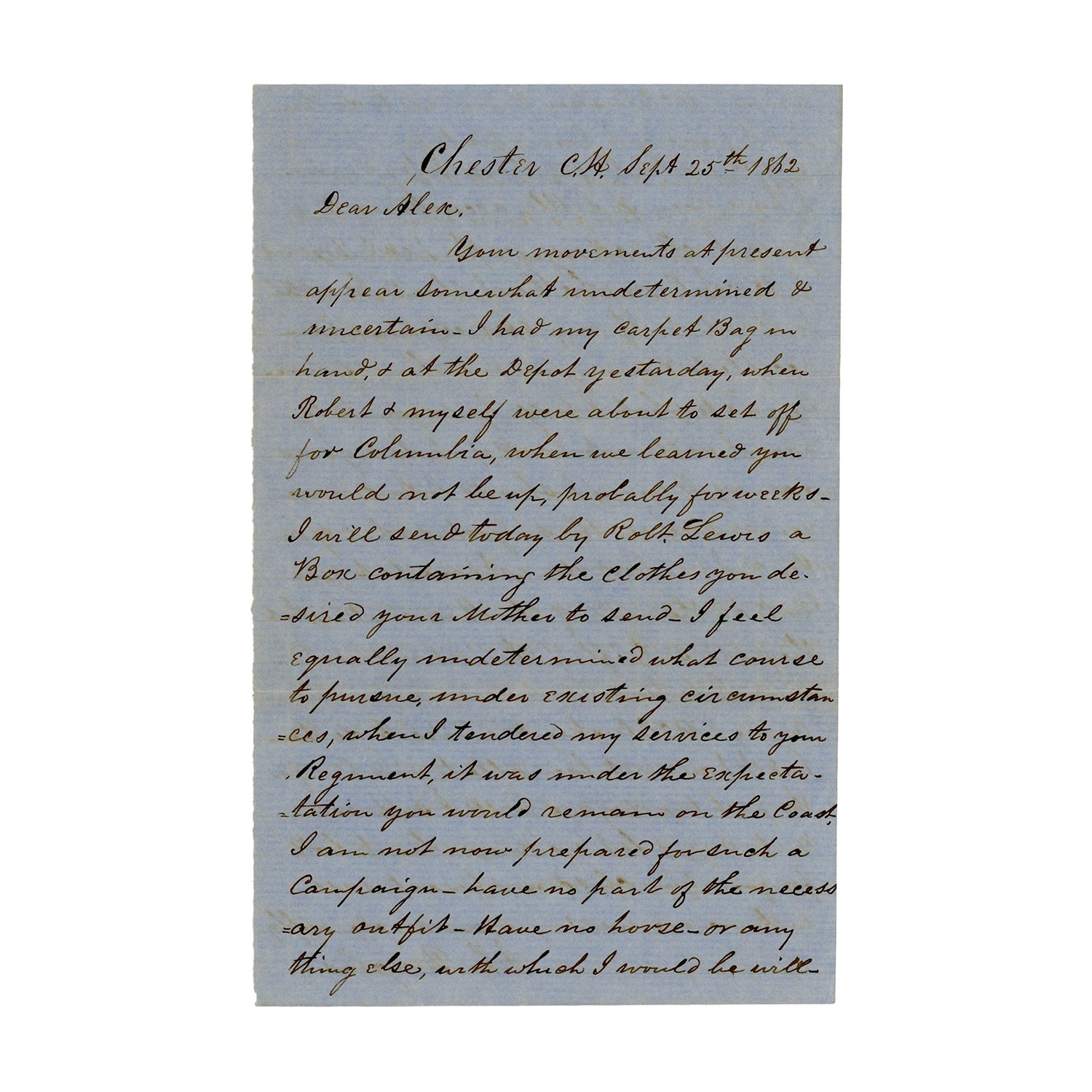
The final letter in the group was written September 25. In it, Douglas remarks that he “had my carpet Bag in hand & at the Depot yesterday,” evidently ready to join Walker as the regiment’s chaplain. He reconsidered, however, after discovering that the regiment would be stationed in Virginia:
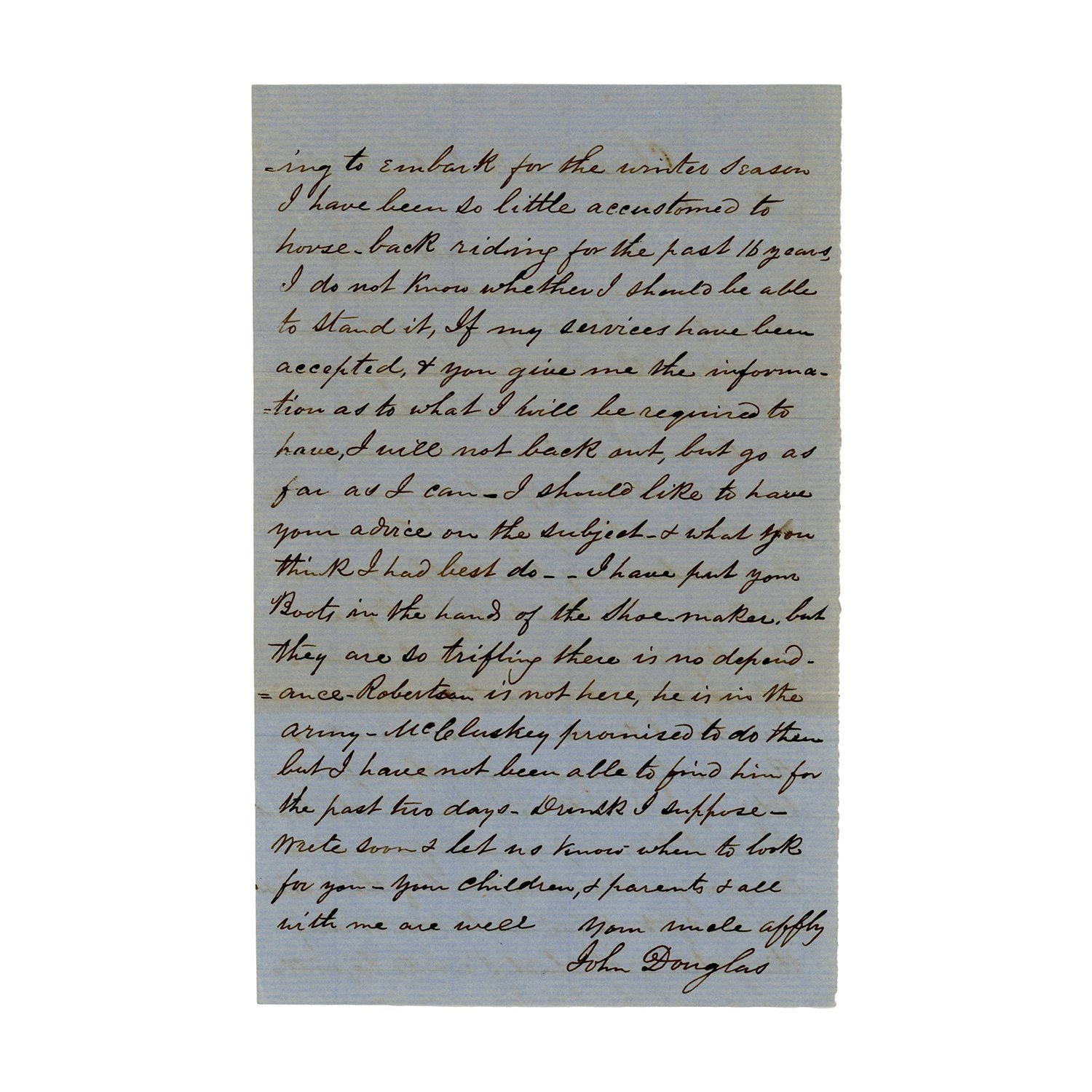
When I tendered my services to your Regiment, it was under the expectation you would remain on the Coast. I am not now prepared for such a Campaign. Have no part of the necessary outfit. Have no horse, or anything else with which I would be willing to embark for the winter season. I have been so little accustomed to horseback riding for the past 16 years. I do not know whether I should be able to stand it. If my services have been accepted, & you give me the information as to what I will be required to have, I will not back out, but go as far as I can.
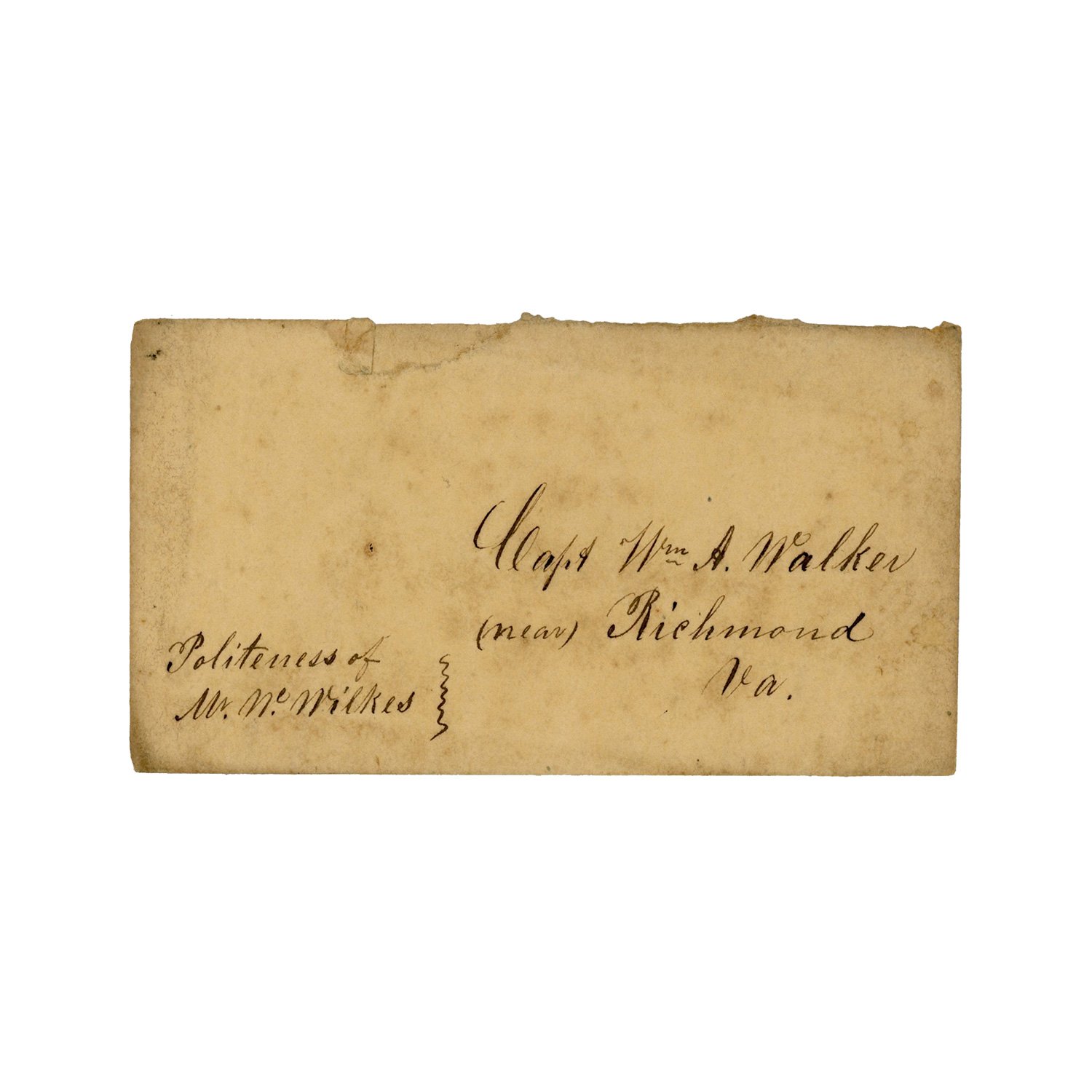
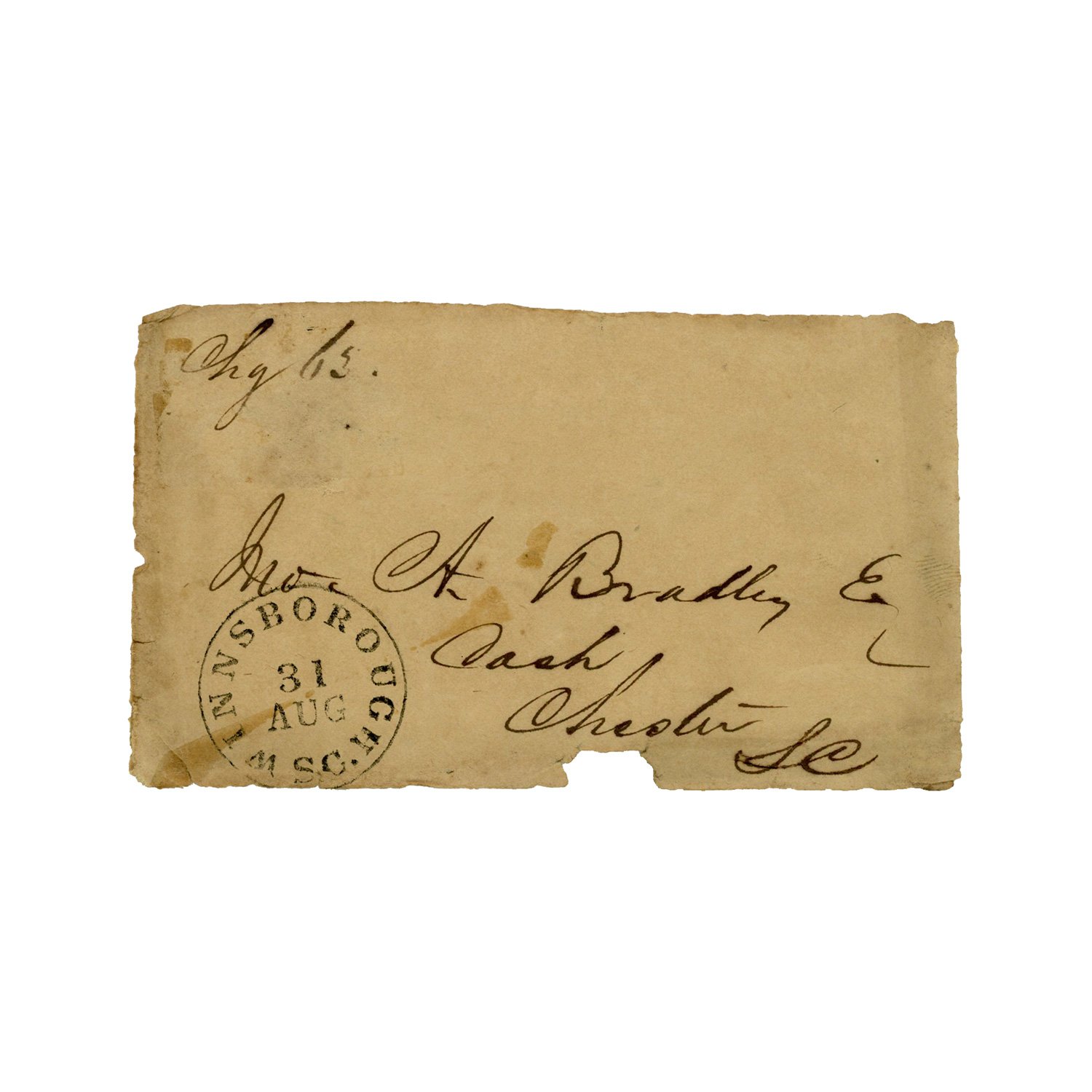
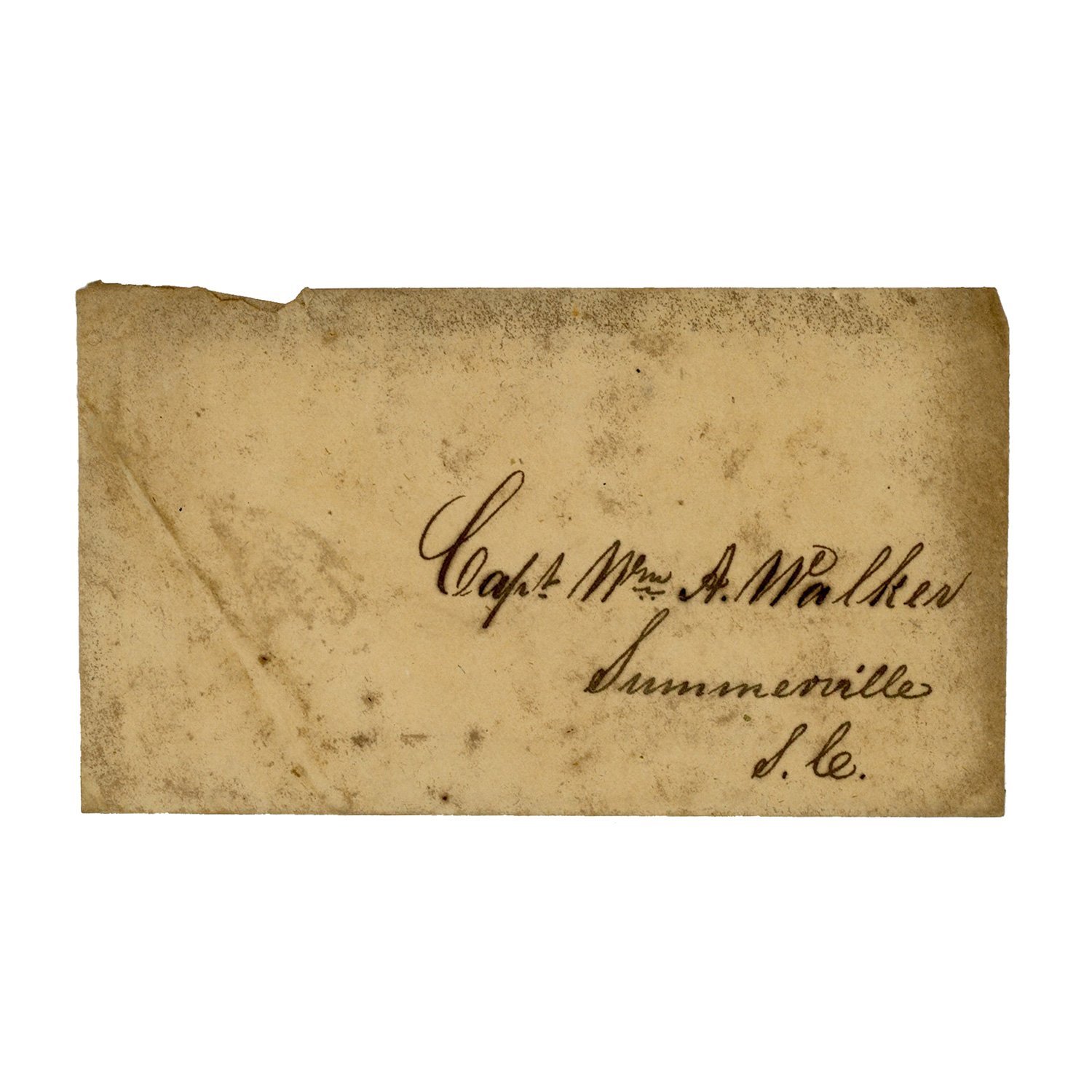
The letters were written on various size letter sheets. Creased at original folds. Two of the original postal covers are included. The full transcripts of the letters appear below.
Letter No. 1:
Chester August 14 1862
Dear Alex
I rec’d your letter yesterday, & we are glad to know you continue well. You will have to use all the precaution possible. Don’t neglect to take the Quinine for at least two weeks, & then after stopping for a few days, resume it again. You will be more liable to fever than if you had been more exposed to the sun during the early part of the Season. As I am just on the eve of going down to assist Mr. Saze with his meeting at Cedar Shoals, I will be brief. We have little beyond the war excitement to write, & upon that you are as well posted as we are. You have seen that Genls. Means & Benbow had a part in the fight at Marvin. They, with others, put the aliens to flight. We have only heard enough to make us quite anxious to hear more. Jackson has also been doing some more good work near Gordonsville. Surely daylight must soon begin to break with us, although there are no rays visible as yet. Robt. Caldwell’s Son & Wm. Brawley are both home & are doing pretty well. I have seen them both. All complain of Va. being the hottest place in the world, & the poorest living. You complain of the Coast, but White’s brother writes back, he would tenfold prefer being on the Coast to be in Va. So it looks like going further & faring worse. I hope your Regiment will not be sent off there.
As to your proffered offer of the Chaplaincy, do you think it a field in which I could be useful? What outfit would it be necessary for me to have? Would I be required to have a horse? Tent? &c. I feel willing to do what I can & think everyone should do so. Inform me on these points soon & I will come down & see about it. I have just returned from your father’s. All are well, the children at school. I have only seen Fanny once since you left. She is well. Your wheat will do better than was feared They have 70 Bushels cleaned & some three loads to thresh yet, which they are at today. It will be over a hundred bushels. Your mother thinks she will send tomorrow some horse shoes, if an opportunity offers. All well with me, & join in kindest love & regard to you.
Your uncle affly
J. Douglas
Write soon & often.
Letter No. 2:
Chester C.H. August 28 1862
Dear Alex
I am much longer in answering your letter than I intended, but have been so much from home as to allow myself little time for letter writing. We also heard your camp had been moved, without knowing where. From a letter your mother rec’d yesterday, I see you still date from the same place. We were glad to learn you were continuing to mend, & could ride your horse without inconvenience. Still, you will have to exercise all the prudence in your power. You must also be on your guard, lest the fever finds you out amid those swamps. Use your quinine freely, and avoid being in the dew as much as possible. Do not be sitting on it, about your tent doors, but keep under curtain all night. Then is the time most of these fevers are contracted. Fall fevers I always regard as the worst.
Things are progressing here as usual. There is kept up a constant war excitement in apprehension of another bloody collision in Va. I saw yesterday one of Col. McDaniel’s sons, who has come home on sick furlough. He said Pope was falling back (as our papers represent) in the direction of Manassas. If Jackson should overtake him, somebody will be hurt. Yesterday’s news informs us Pope was leaving his sick & wounded behind. If that is so, he must be pushed & may be overtaken soon.
This community has again been saddened by the news of the death of both of John McNinch’s sons. He went on to see them last week & just got there in time to see the last die. They will be brought home & be buried here. It is a heavy blow to poor John & family. They were good & well behaved boys. Died with disease in the hospital. You will probably be surprised to learn Holtz has joined the Methodist Church. Bro Picket has succeeded in opening his eyes to the truth of a true work. A good thing for him. One of his daughters joined at the same time. You can say to your Lieutenant Crawford I saw his wife & friend a week ago at Cedar Shoals. All well. Old Mr. Davidson of that Congregation lost one of his sons in Va. He was brought home & buried in the same yard with the Gastons. This horrible war is filling many a family with sorrow & mourning. Your parents, children, & all your friends around are well. I spent last Saturday night at Mr. Ramey’s, preached at Bethesda on Sabbath, Mr. Harris being absent.
Your Col. is slow in his zeal for a chaplain. Perhaps he has something else to occupy his thoughts. We hear he was under arrest. I would not, of course, put myself in the way of an appointment & could not now come before the 16 of Sept., as I have duties requiring my presence here & hereabouts. My family are all well & join in kindest love to you. Believe me as ever your uncle affely
John Douglas
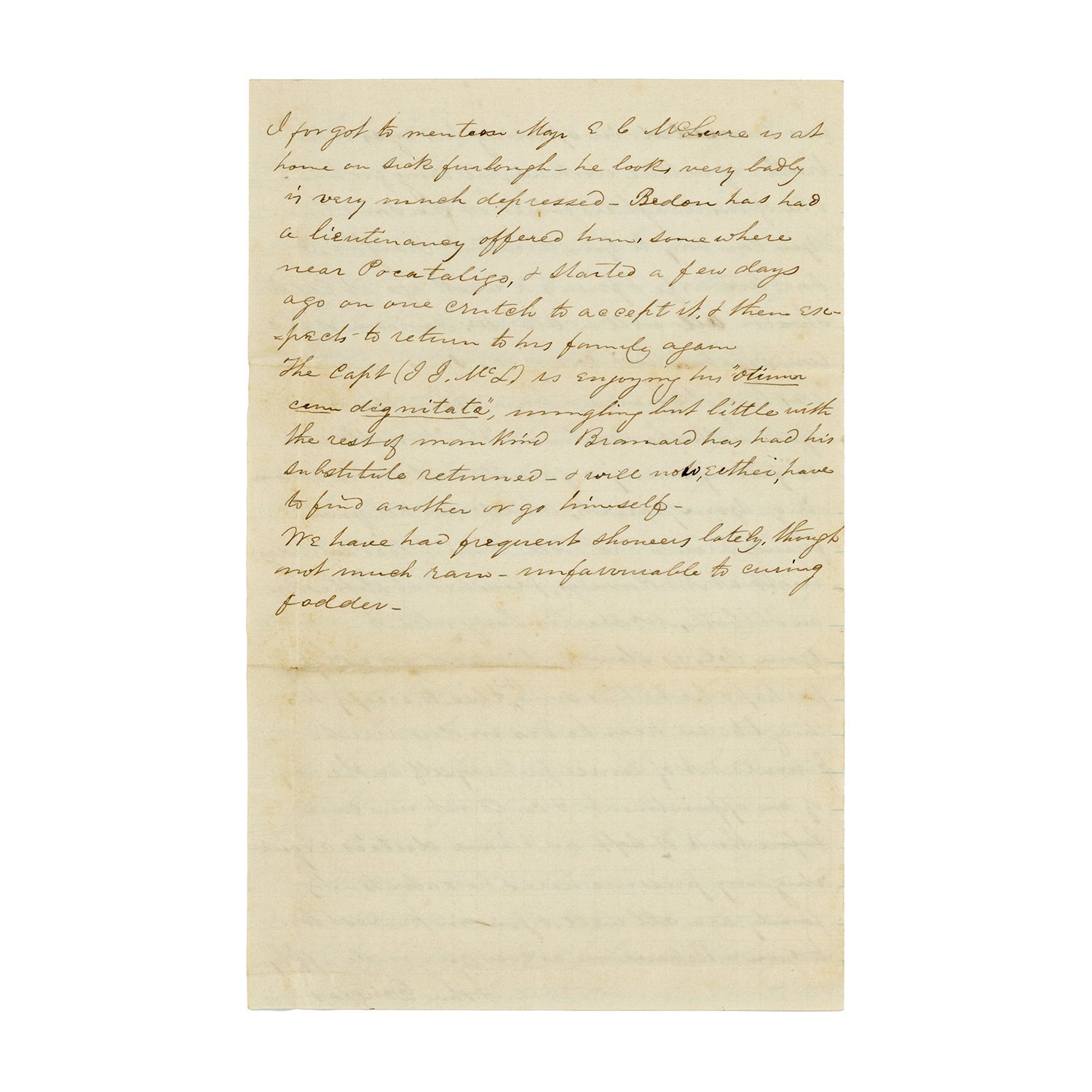
I forgot to mention Major E. C. McLure is at home on sick furlough. He looks very badly. Is very much depressed. Beden has had a lieutenancy offered him somewhere near Pocataligo & started a few days ago on one crutch to accept it, & then expects to return to his family again. The Capt. (J. J. McL.) is enjoying his “otium cum dignitate,” mingling but little with the rest of mankind. Branard has had his substitute returned & will now either have to find another or go himself.
We have had frequent showers lately, though not much rain. Unfavorable to curing fodder.
Letter No. 3:
Chester Sept. 10 1862
Dear Alex
Absence from home has, in part, prevented me from answering your letter sooner. At this season of the year, sacramental meetings are frequent & I am favored with a general invitation. The meeting begins tomorrow night at Bethesda, & I suppose will be attended with the usual crowd. I expect to attend a part of the time. I am becoming very tired of their promiscuous labour, & would be glad to settle down again to regular duties. But these terrible, troublous times, seem to be averse to everything of a quiet nature, & I must, like everyone else, make the best of my lot.
The last battle at Manassas seems encouraging to us. A great but costly victory. Our loss has been immense. Some of our noblest men have been called out. Of the Chester Grays, of the 38 who went into the fight, only 2 escaped unhurt. Garner White’s son is killed. Beard wounded &c. Scott Wilson is again wounded. Dr. Reedy left last night to go onto the field of carnage, to render what aid he could to the suffering survivors, & particularly to his acquaintances. Troy Donuvant’s son is wounded. He went on to him, so soon as he heard it. The Capt. of the Grays, no doubt, thinks his resignation was specially opportune, & is glad he is at home rather than in Va.
Col. Means, Gadberry, Marshall, Moore all killed. I did regret so much to hear the death of Means. Genl. Jenkins was wounded in two places, not seriously. He is now home in York. His brother, Capt. J. Jenkins, passed down yesterday. From him I obtained my information. I came down on Monday from Charlotte in company with Lieut. Col. Farrow (Beden’s brother-in-law). He was wounded in two places, but not dangerously. Beden has rec’d an appointment in a company on the Coast near Grahamville. His wound is nearly well, but he suffers from dysentery. He is at present at Wilson’s Springs N.C. to see what the waters will do for him.
Our Telegram yesterday (if true) are very encouraging. Lexington Ky. has been taken. Covington & Cincinnati, & our forces had crossed the Potomac & were now in Maryland, near Baltimore. These are trying times! And attended with great sacrifice of valuable lives. I neglected to mention the probable death of Capt. John Witherspoon of York. Genl. Jenkins said he did not think there was any hope of his recovery. He was a most excellent young man, just married & only spent one night with his wife. She & his mother have gone on, but I fear will not be able to reach him in time, if at all. That was a sad duel between Rhett & Calhoun. The former passed here yesterday on his way, I suppose, to Richmond. He ought to be suspended by the heels until his enemies should respite him.
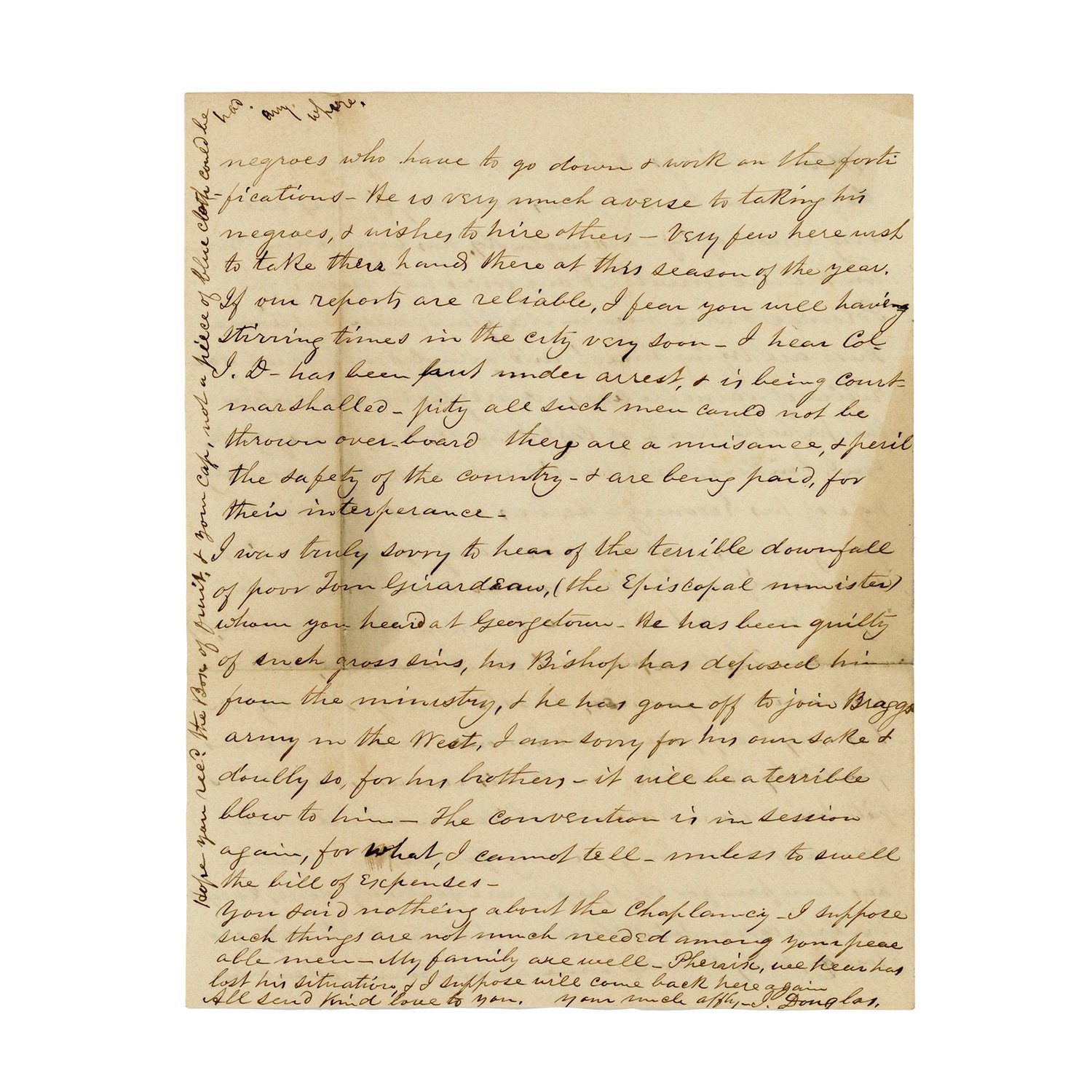
Your parents & children are all well. Your people are busy pulling fodder. The weather has been fine for it, & people are generally done, except the late corn. Jas. McLure went down to the city yesterday to try & make some arrangements about his negroes, who have to go down & work on the fortifications. He is very much averse to taking his negroes, & wishes to hire others. Very few here wish to take their hand there at this season of the year. If our reports are reliable, I fear you will have stirring times in the city very soon. I hear Col. J. D. has been put under arrest & is being court marshalled. Pity all such men could not be thrown overboard. They are a nuisance & peril the safety of the country, & are being paid for their interperance.
I was truly sorry to hear of the terrible downfall of poor Tom Girardeau (the Episcopal minister) whom you heard at Georgetown. He has been guilty of such gross sins, his Bishop has deposed him from the ministry, & he has gone off to join Bragg’s army in the West. I am sorry for his own sake, & doubly so for his brothers. It will be a terrible blow to him. The convention is in session again, for what I cannot tell, unless to swell the bill of expenses.
You said nothing about the Chaplaincy. I suppose such things are not much needed among your peaceable men. My family are well. Pherrin, we hear, has lost his situation, & I suppose will come back here again. All send kind love to you.
Your uncle affly
J. Douglas
Hope you rec’d the Box of fruit & your cap. Not a piece of blue cloth could be had anywhere.
N.B. I think it would your best plan to send Fanny up to Salem & put her to school there. She ought to be somewhere where her education would be well attended to. This I say to you.
Maj. William mentioned to me a few days ago. A malicious report some vile wretches were circulating about you & the monies allowed for clothing the army. How about it?
Letter No. 4:
Chester C.H. Sept. 25th 1862
Dear Alex,
Your movements at present appear somewhat undetermined & uncertain. I had my carpet Bag in hand & at the Depot yesterday, when Robert & myself were about to set off for Columbia, when we learned you would not be up, probably for weeks. I will send today by Robt. Lewis a Box containing the clothes you desired your Mother to send. I feel equally undetermined what course to pursue, under existing circumstances. When I tendered my services to your Regiment, it was under the expectation you would remain on the Coast. I am not now prepared for such a Campaign. Have no part of the necessary outfit. Have no horse, or anything else with which I would be willing to embark for the winter season. I have been so little accustomed to horseback riding for the past 16 years. I do not know whether I should be able to stand it. If my services have been accepted, & you give me the information as to what I will be required to have, I will not back out, but go as far as I can. I should like to have your advice on the subject, & what you think I had best do. I have put your Boots in the hand of the Shoemaker, but they are so trifling, there is no dependance. Robertson is not here. He is in the army. McCluskey promised to do them, but I have not been able to find him for the past two days. Drunk, I suppose. Write soon & let us know when to look for you. Your children & parents & all with me are well.
Your uncle affly
John Douglas
Quisque iaculis facilisis lacinia. Mauris euismod pellentesque tellus sit amet mollis.