
1864 Letter by Brigadier General Innis N. Palmer, Settling Dispute Over Soldier Pay Between Paymaster and His Staff Member
1864 Letter by Brigadier General Innis N. Palmer, Settling Dispute Over Soldier Pay Between Paymaster and His Staff Member
Item No. 5917340
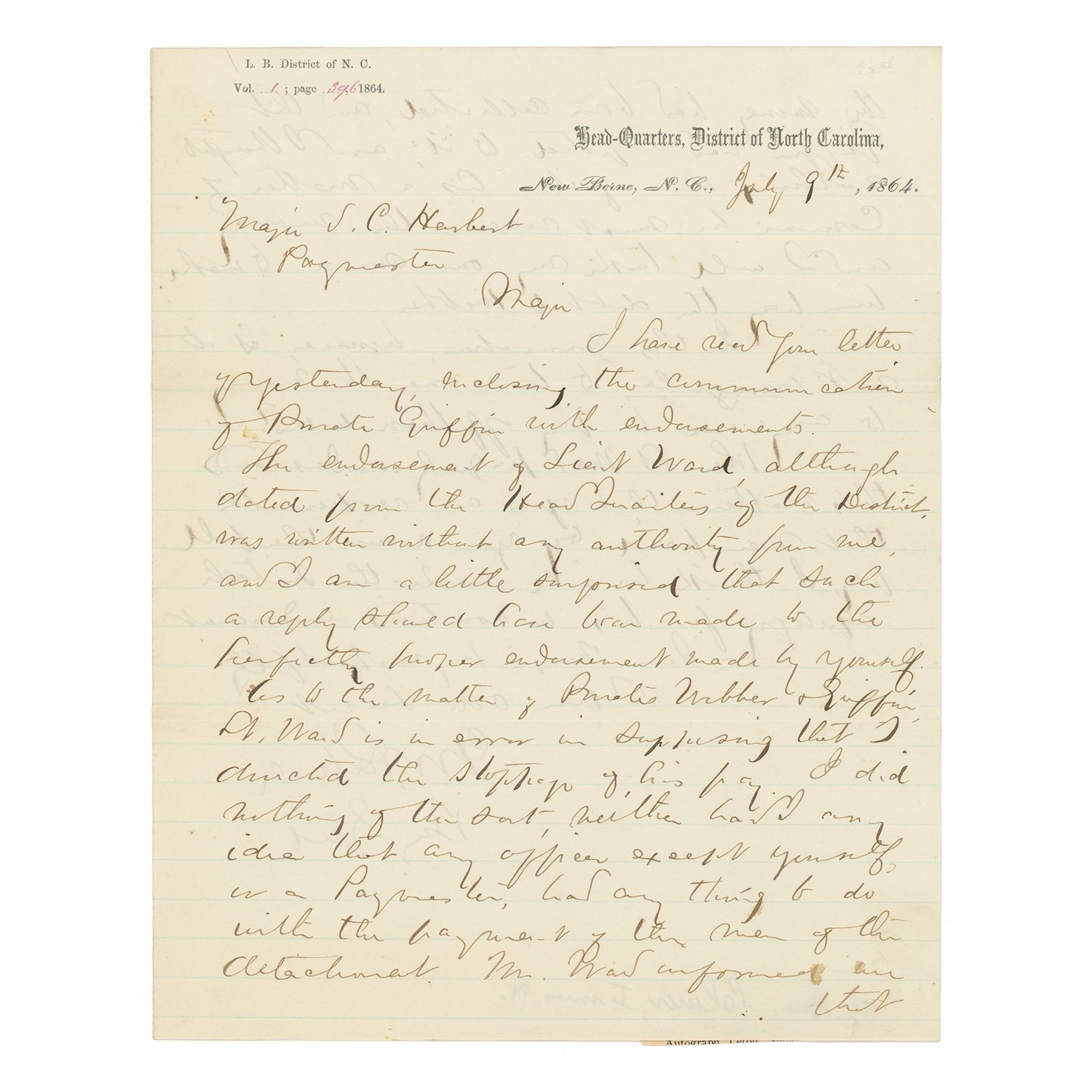
In this July 1864 autograph signed letter, Brigadier General Innis N. Palmer, commanding the District of North Carolina, seeks to settle a dispute over soldier pay, where a Lieutenant Ward of his staff evidently withheld the wages of a soldier by amending a pay document, thereby circumventing paymaster Major Samuel C. Harbert. Writing to Harbert, Palmer states that Ward’s intervention “was written without any authority from me” and that he was “a little surprised that such a reply should have been made to the perfectly proper endorsement made by yourself.” He adds that Ward “was in error in supposing that I directed the stoppage” of a Private Griffin’s pay, and that “when Lt. Ward properly understands this matter—that you are responsible that men paid by you receive the full pay—I think he will make the suitable apology for his uncourteous endorsement.” The general signs, “I. N. Palmer / Brig. Genl.”
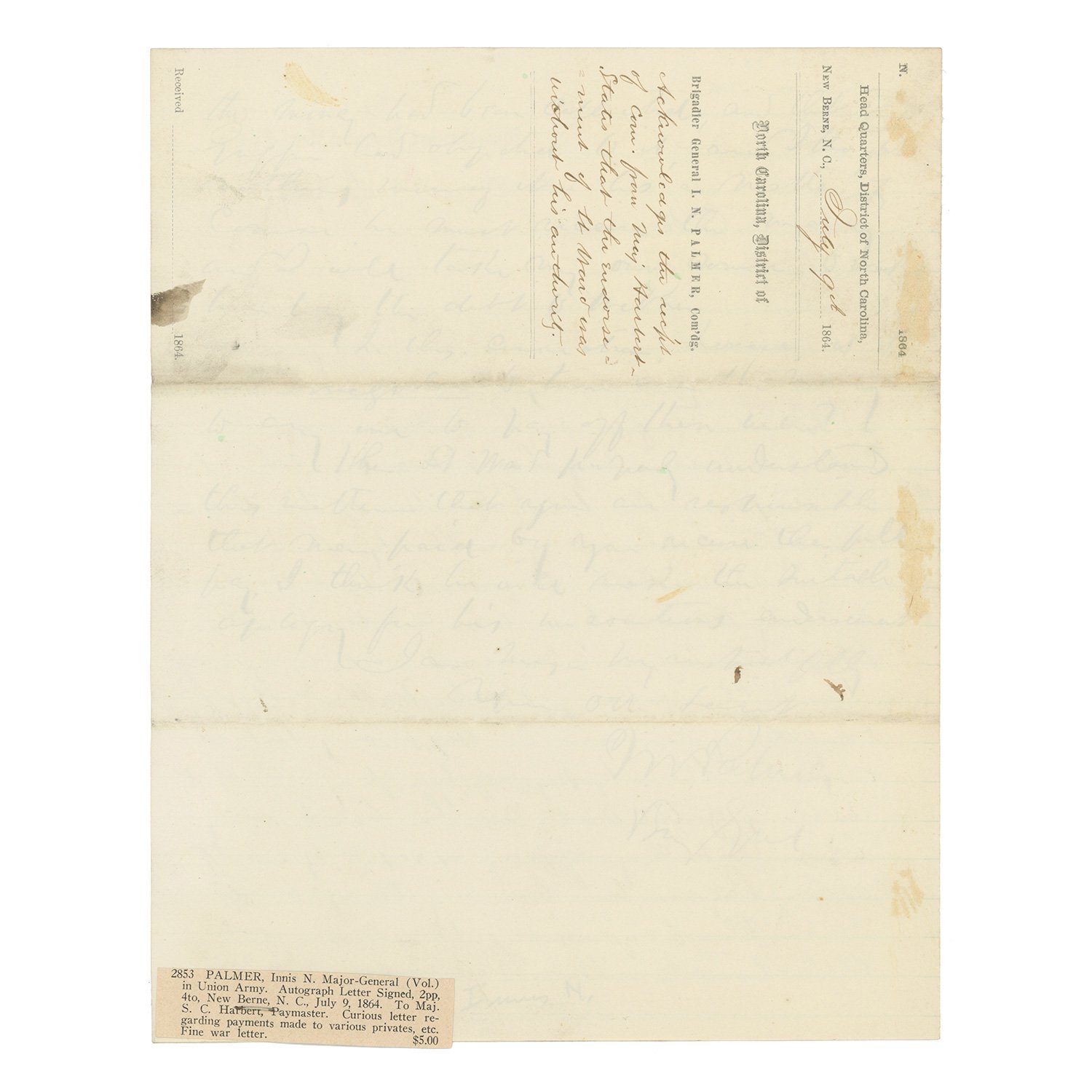
Briefly docketed on the reverse, where a small biographical excerpt is stapled.
The letter was written on two pages of a four-page sheet of Department of North Carolina letterhead measuring about 7 3/4” x 9 3/4”. Creased at the original folds. The full transcript can be found below.
From The Union Army, vol. 8
Palmer, Innis N., brigadier-general, was born in Buffalo, N. Y. March 30, 1824. He was graduated at the United States military academy in 1846 and served throughout the Mexican war, where he was wounded at Chapultepec, won the brevets of 1st lieutenant and captain for gallantry at Contreras, Churubusco and Chapultepec, and took part in the assault on and capture of the City of Mexico. He was afterwards on frontier and recruiting duty, and was promoted major, April 5, 1861, having attained the intervening grades. He served from April to July, 1861, in the defenses of Washington, and in the Manassas campaign he commanded the battalion of United States cavalry at the battle of Bull Run, winning promotion to brevet lieutenant-colonel by gallantry there. He was transferred to the 5th cavalry in Aug., 1861, was commissioned brigadier-general of volunteers on Sept. 23, and commanded a brigade in the 4th army corps of the Army of the Potomac during the Virginia Peninsular campaign being engaged at Yorktown, Williamsburg, Fair Oaks, and in the Seven Days' battles. He was subsequently engaged in organizing and forwarding to the field New Jersey and Delaware troops and in superintending camps of drafted men at Philadelphia, Pa., in 1862; commanded then the 1st division of the 18th army corps in North Carolina from Jan. to July, 1863, the Department of North Carolina, February to March, the District of Pamlico, the 18th army corps and the defenses of New Berne, N. C., March, 1863, to April, 1864, and then the districts of North Carolina and Beaufort, N. C., successively until June, 1865. He was promoted lieutenant-colonel and transferred to the 2nd cavalry, Sept. 23, 1863, and on March 13, 1865, was brevetted brigadier-general in the regular army and major-general of volunteers. He was promoted colonel in June, 1868, and commanded his regiment at various posts until retired at his own request in March, 1879. He died in Chevy Chase, Md., Sept. 10, 1900.
Head-Quarters, District of North Carolina,
New Berne, N.C., July 9th, 1864.
Major S. C. Harbert
Paymaster
Major
I have rec’d your letter of yesterday, enclosing the communication of Private Griffin with endorsements. The endorsement of Lieut. Ward, although dated from the Head Quarters of the District, was written without any authority from me, and I am a little surprised that such a reply should have been made to the perfectly proper endorsement made by yourself.
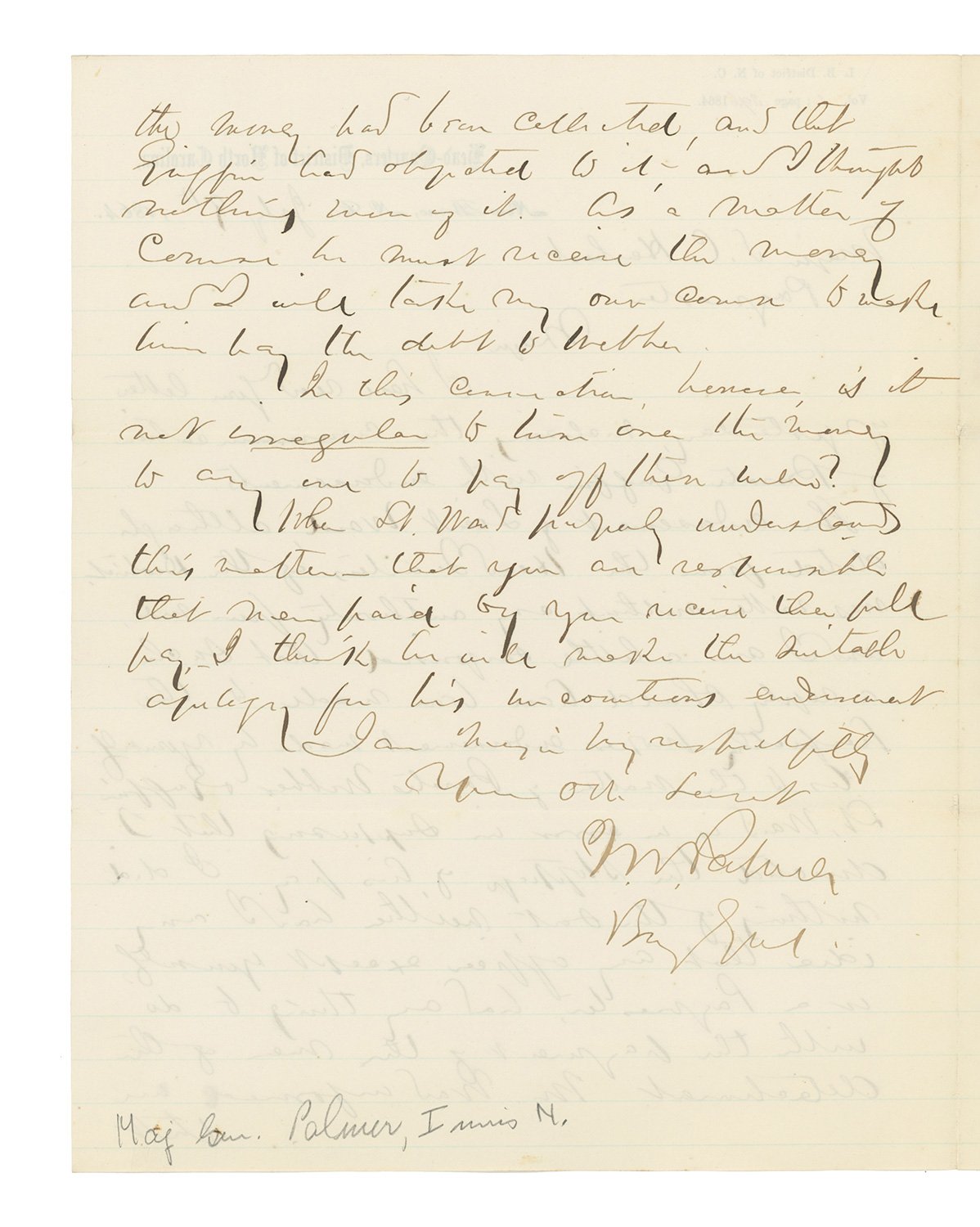
As to the matter of Privates Webber & Griffin, Lt. Ward was in error in supposing that I directed the stoppage of his pay. I did nothing of the sort, neither have I any idea that any officer except yourself, or a Paymaster, had anything to do with the payment of the men of the detachment. Mr. Ward informed me that the money had been collected, and that Griffin had objected to it, and I thought nothing more of it. As a matter of course, he must receive the money, and I will take my own course to make him pay the debt to Webber.
In this correction, however, is it not irregular to turn over the money to anyone to pay off their debts?
When Lt. Ward properly understands this matter—that you are responsible that men paid by you receive the full pay—I think he will make the suitable apology for his uncourteous endorsement.
I am, Major, very respectfully
Your obt. servt.
I. N. Palmer
Brig. Genl.