
1862 Letter by Sergeant Charles S. Cockett, 70th New York, Excelsior Brigade — Battle of Fair Oaks — Battle of Williamsburg — Celebrating the Return of General Daniel Sickles
1862 Letter by Sergeant Charles S. Cockett, 70th New York, Excelsior Brigade — Battle of Fair Oaks — Battle of Williamsburg — Celebrating the Return of General Daniel Sickles
Sickles was here to lead them…. When he came here to take command of his Brigade, he received the greatest reception that ever I saw. He visited each Regiment separately in their camps. When he came to our Regiment, the boys turned out, & such cheering was never heard before. The boys took him in their arms & carried him around. He was so full he could not speak. O, he was glad. After the cheering subsided a little, he shook hands with the officers & men, & then said, “Boys, I have come to stay with you this time.” It was all he could say, but the cheering was longer & louder than before (if that were possible). The cheered until they could cheer no more. I never saw men feel so glad in my life, & it was every many too. There was no exceptions. All turned out to do him honor, & Your Humble Servt was as glad as any of them.
Item No. 5509007
A fascinating letter written by Sergeant Charles S. Cockett, 70th New York Volunteers, Excelsior Brigade, dated June 2, 1862. Writing from a field hospital near Richmond to his friend in New York, Cockett discusses the Battle of Fair Oaks, ruminates on war news, laments the men lost at the Battle of Williamsburg, and celebrates his brigade commander General Daniel E. Sickles.
Cockett opens the letter explaining his hospitalization—an accidental knife wound sustained while cutting tent pins. He writes, “I have felt sorry that I could not be with my Regiment in yesterday’s fight [at Fair Oaks], but it was impossible, as I am so lame & cannot get along much. The wound is in a bad place, it being so close to the knee joint that it stiffens the joint & makes the cords & muscles very sore.”
Of the fighting at Fair Oaks on May 31, Cockett notes that Union troops of General Silas Casey’s division “were driven back some two miles” and that General Joseph Hooker’s division, in which the 70th served:
was ordered forward to support them, but did not get in in time that night, but they were on hand Sunday morning [June 1] & opened the fight again, & they drove the rebels back again at a charge bayonet, and without much loss to us. But the Rebels suffered terribly. It was very exciting to us here, as we could hear the whole of it. Some of the time, they were only three miles off & we could hear the musketry very distinct.
Cockett then turns his attention to other war news, discussing the implications of Confederate General P.G.T. Beauregard’s withdrawal from Corinth in Mississippi:
Rumor says Beauregard has evacuated Corinth, & I place great credit to it, for I think they are getting scared here at Richmond, & will want Beauregard’s assistance. We are getting mighty close onto them & they have either got to give us Richmond or else fight, & then give it to us. If Beauregard can get his forces here before we can get reinforcements, they will give us all we can attend to & perhaps more.
Cockett also addresses the failure of Union forces to hold the Shenandoah Valley:
I felt mortified and saddened when the news came of Banks being driven back. I supposed he had force enough to hold his position easily. We lost many valuable lives to get possession of the Shenandoah Valley & now we have lost it again, & even Washington is threatened. But as far as the Capital is concerned, I apprehend no danger, for I don’t believe they could take it if all their troops should besiege it.
Perhaps the most interesting part of the letter is where Cockett describes the reception received by General Daniel Sickles upon returning to the Excelsior Brigade shortly before the Battle of Fair Oaks. Sickles’ initial brigadier’s commission had not been approved by the Senate, and he had traveled to Washington to lobby Republican friends, including President Lincoln, to reconsider his position. The Senate approved the commission on May 13 and Sickles quickly boarded ship to return to his brigade. Cockett writes:
The Regiment lays about 7 or 8 miles from here under arms all the time. Sickles was here to lead them. I have no doubt you saw his appointment & confirmation sometime since. When he came here to take command of his Brigade, he received the greatest reception that ever I saw. He visited each Regiment separately in their camps. When he came to our Regiment, the boys turned out, & such cheering was never heard before. The boys took him in their arms & carried him around. He was so full he could not speak. O, he was glad. After the cheering subsided a little, he shook hands with the officers & men, & then said, “Boys, I have come to stay with you this time.” It was all he could say, but the cheering was longer & louder than before (if that were possible). The cheered until they could cheer no more. I never saw men feel so glad in my life, & it was every many too. There was no exceptions. All turned out to do him honor, & Your Humble Servt was as glad as any of them.
Sickles had been in Washington when the 70th fought in its first battle at Williamsburg on May 5. The outcome had been much different there, with the Excelsiors being cut to pieces in an unsuccessful attack. Cockett writes:
One of our wounded boys have died since I wrote you last. His name was Wm. H. Price, making eleven in all that we lost in the fight at Williamsburg, besides the wounded. The rest of them are doing well at last account. Some are in Philadelphia & some at Fortress Monroe. Our Col. [William Dwight] is slowly gaining, & they have hopes he will get well, notwithstanding his wound is a very bad one. He is at the Insane Asylum at Washington at their request. Our Lieut. Col. [John E. Farnum] is also gaining. There is occasional firing of heavy pieces today. It seems to come from the right. No Small Arms has been heard here. They are too distant to be heard, if there is any fighting.
Near the end of the letter, Cockett—who with most of Company C was native to Michigan—remarks about a Michigan regiment. “I presume you saw the account of the fight at Hanover Court House, as also the fight of the 4th Michigan Regt near New Bridge,” he writes. “We drove them in both those places, as we always do.” He closes, “I am now 3rd Sergt. of Co. (C). Give me cheer.”
The letter was written on four pages of a bifolium letter sheet measuring about 5” x 8”. Very light foxing. Creased at the original folds. The full transcript appears below.
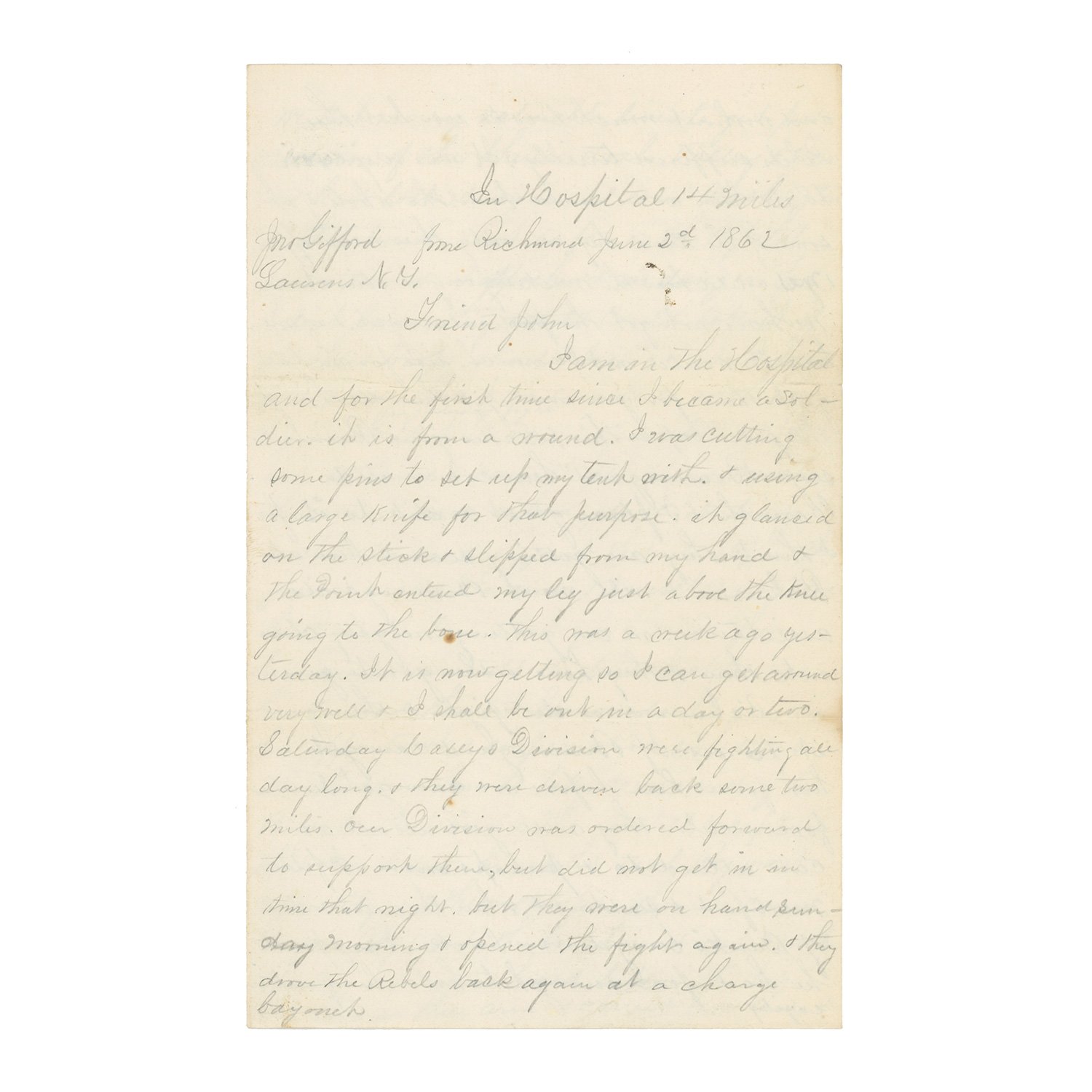
In Hospital 14 miles
from Richmond June 2d 1862
Jno. Gifford
Laurens N.Y.
Friend John
I am in the Hospital, and for the first time since I became a soldier. It is from a wound. I was cutting some pins to set up my tent with, & using a large knife for that purpose, it glanced on the stock & slipped from my hand, & the point entered my leg just above the knee going to the bone. This was a week ago yesterday. it is now getting so I can get around very well, & I shall be out in a day or two.
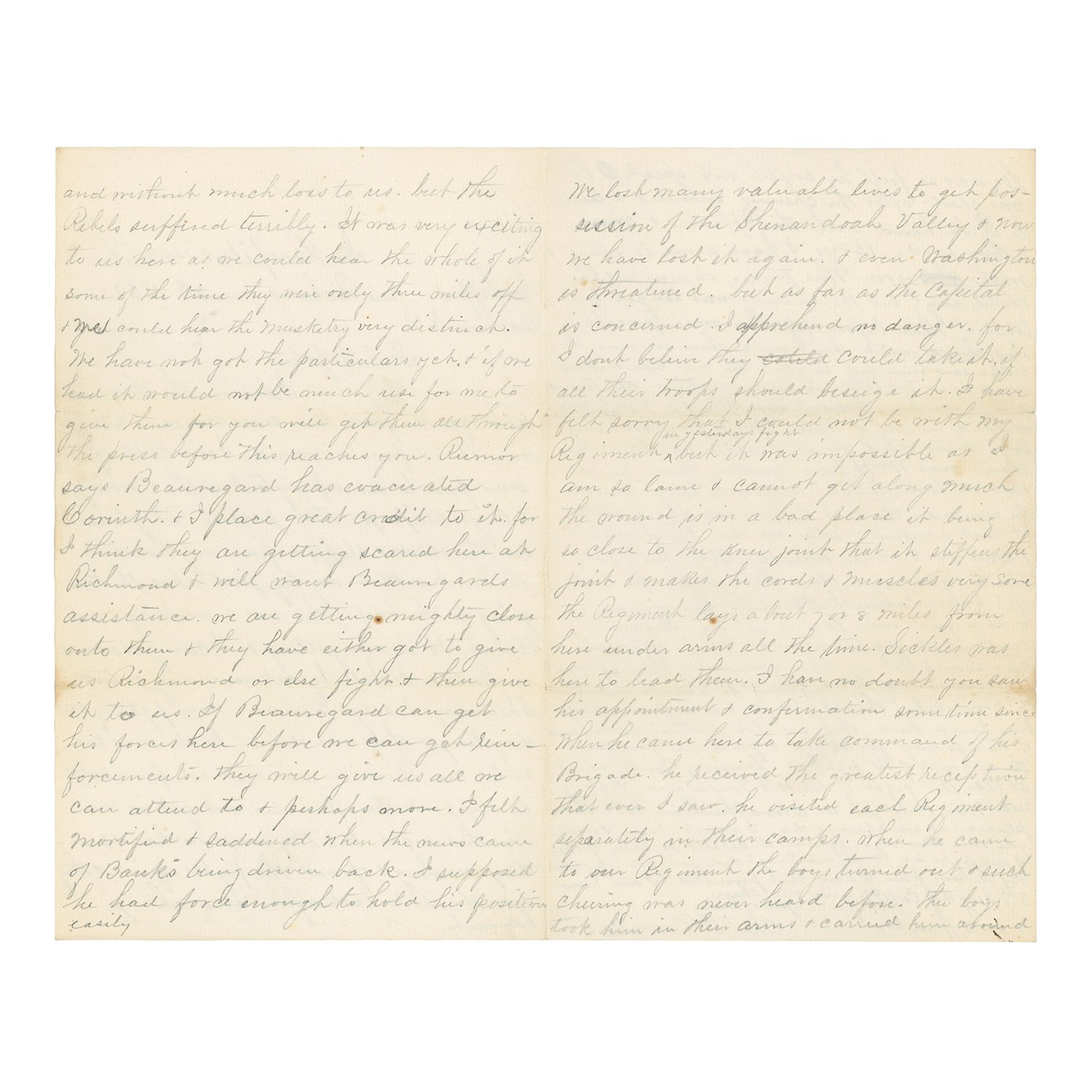
Saturday, Casey’s Division were fighting all day long & they were driven back some two miles. Our Division was ordered forward to support them, but did not get in in time that night, but they were on hand Sunday morning & opened the fight again, & they drove the Rebels back again at a charge bayonet, and without much loss to us. But the Rebels suffered terribly. It was very exciting to us here, as we could hear the whole of it. Some of the time, they were only three miles off & we could hear the musketry very distinct. We have not got the particulars yet, & if we had, it would not be much use for me to give them, for you will get them all through the press before this reaches you.
Rumor says Beauregard has evacuated Corinth, & I place great credit to it, for I think they are getting scared here at Richmond, & will want Beauregard’s assistance. We are getting mighty close onto them & they have either got to give us Richmond or else fight, & then give it to us. If Beauregard can get his forces here before we can get reinforcements, they will give us all we can attend to & perhaps more. I felt mortified and saddened when the news came of Banks being driven back. I supposed he had force enough to hold his position easily. We lost many valuable lives to get possession of the Shenandoah Valley & now we have lost it again, & even Washington is threatened. But as far as the Capital is concerned, I apprehend no danger, for I don’t believe they could take it if all their troops should besiege it.
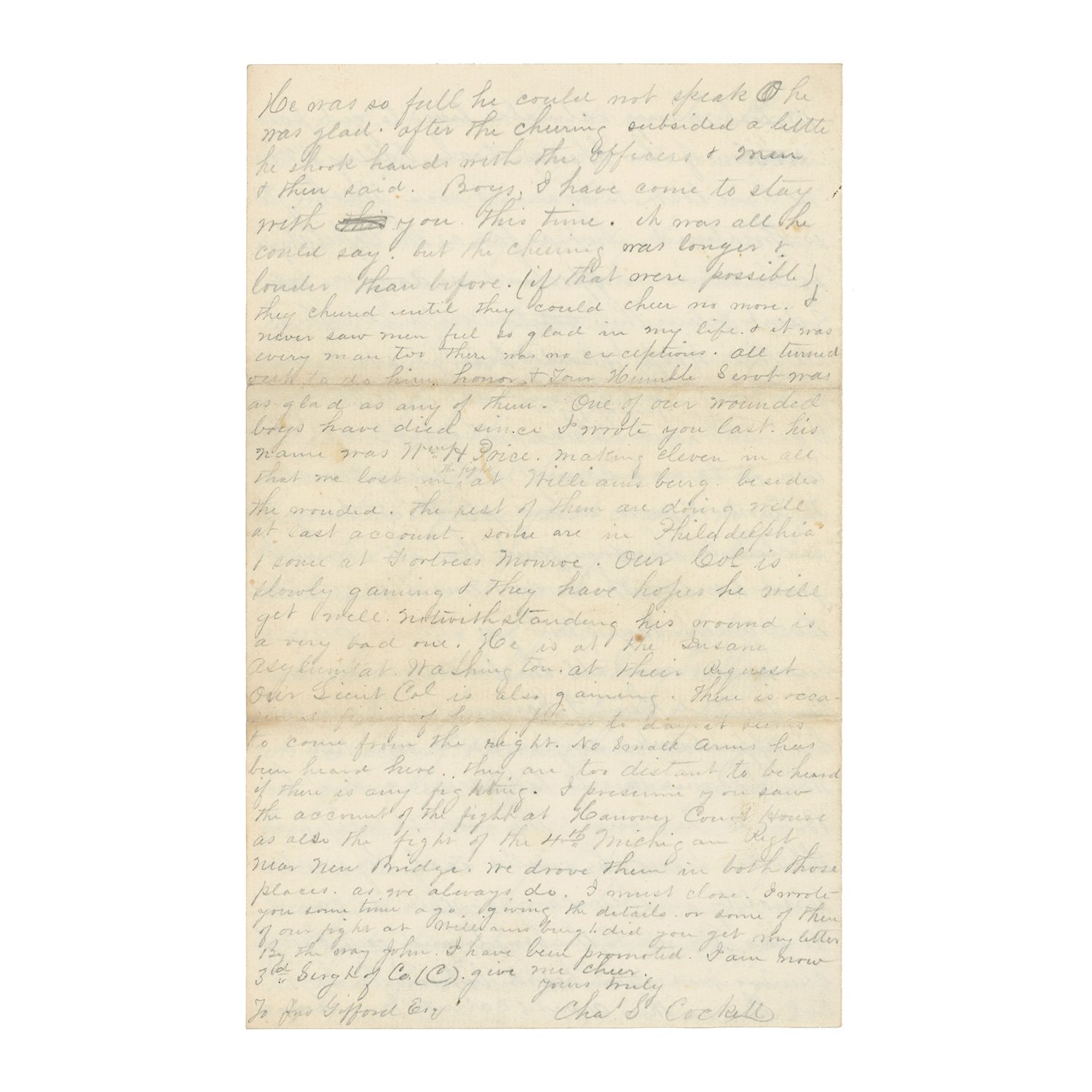
I have felt sorry that I could not be with my Regiment in yesterday’s fight, but it was impossible, as I am so lame & cannot get along much. The wound is in a bad place, it being so close to the knee joint that it stiffens the joint & makes the cords & muscles very sore. The Regiment lays about 7 or 8 miles from here under arms all the time. Sickles was here to lead them. I have no doubt you saw his appointment & confirmation sometime since. When he came here to take command of his Brigade, he received the greatest reception that ever I saw. He visited each Regiment separately in their camps. When he came to our Regiment, the boys turned out, & such cheering was never heard before. The boys took him in their arms & carried him around. He was so full he could not speak. O, he was glad. After the cheering subsided a little, he shook hands with the officers & men, & then said, “Boys, I have come to stay with you this time.” It was all he could say, but the cheering was longer & louder than before (if that were possible). The cheered until they could cheer no more. I never saw men feel so glad in my life, & it was every many too. There was no exceptions. All turned out to do him honor, & Your Humble Servt was as glad as any of them.
One of our wounded boys have died since I wrote you last. His name was Wm. H. Price, making eleven in all that we lost in the fight at Williamsburg, besides the wounded. The rest of them are doing well at last account. Some are in Philadelphia & some at Fortress Monroe. Our Col. is slowly gaining, & they have hopes he will get well, notwithstanding his wound is a very bad one. He is at the Insane Asylum at Washington at their request. Our Lieut. Col. is also gaining. There is occasional firing of heavy pieces today. It seems to come from the right. No Small Arms has been heard here. They are too distant to be heard, if there is any fighting.
I presume you saw the account of the fight at Hanover Court House, as also the fight of the 4th Michigan Regt near New Bridge. We drove them in both those places, as we always do.
I must close. I wrote you some time ago, giving the details, or some of them, of our fight at Williamsburg. Did you get my letter? By the way, John, I have been promoted. I am now 3rd Sergt. of Co. (C). Give me cheer.
Yours truly
Chas. S. Cockett
To Jno. Gifford Esq.