
Signed Cabinet Card of Bernard J. D. Irwin, Noted Army Surgeon, Naturalist, and Medal of Honor Recipient, by F. Guidi & Pacini, Florence, Italy, 1879
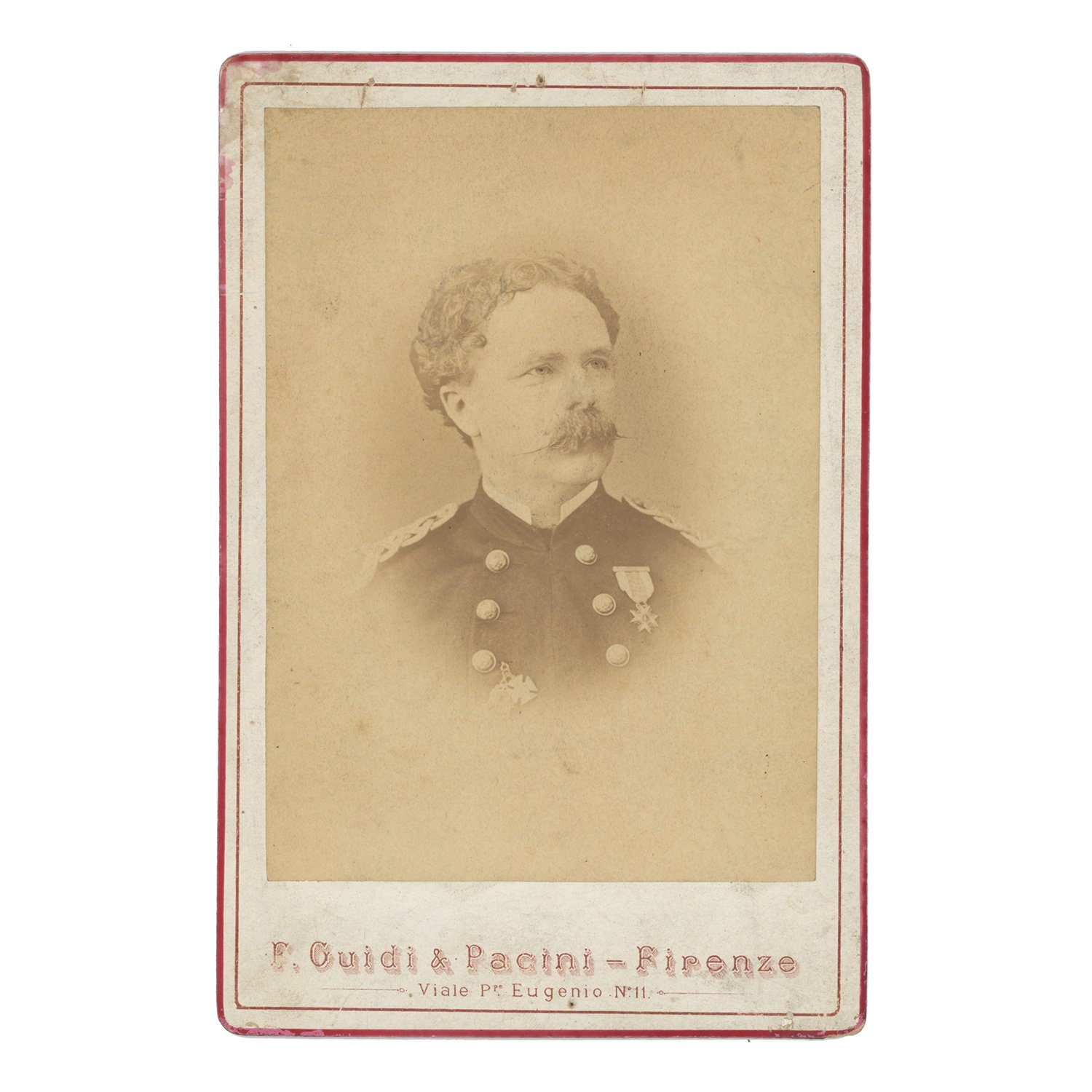
Signed Cabinet Card of Bernard J. D. Irwin, Noted Army Surgeon, Naturalist, and Medal of Honor Recipient, by F. Guidi & Pacini, Florence, Italy, 1879
Item No. 9612291
A wonderful signed cabinet card portrait of Bernard J. D. Irwin, the career U.S. Army surgeon known as the “Fighting Doctor” for his service on the western frontier. In February 1861, while stationed in Arizona, he led a detachment to relieve troops besieged by Apaches under Cochise, an action that earned him the Medal of Honor in 1894. His was the earliest action chronologically for which the Medal was ever awarded.
An avid naturalist, Irwin helped bring the remarkable, approximately 1,400-pound Tucson Ring meteorite to the Smithsonian Institution after finding it abandoned in Tucson. The iron mass is now known as the Irwin–Ainsa meteorite and is on display today near the Hope Diamond.
During the Civil War, Irwin served as a senior medical officer in the Army of the Ohio, establishing a 300-bed tent field hospital at Shiloh in April 1862, one of the earliest battlefield hospitals. He was captured at the Battle of Richmond, Kentucky, while attempting to aid wounded General William “Bull” Nelson, and later was the third man in the room at Louisville’s Galt House hotel during the heated argument between Nelson and his division commander General Jefferson C. Davis, which shortly after culminated with Davis murdering Nelson.
Irwin directed military hospital operations in Memphis from 1863 to 1865, where he ran in the upper-echelon command circles of the western theater. He continued his Army medical career after the war, becoming the first surgeon of the 7th U.S. Cavalry when it formed at Fort Riley in 1866. There he met, treated, and cultivated a friendship with George and Libby Custer..
Later service took Irwin to Detroit and West Point. He eventually attained the rank of brigadier general on the retired list in 1904. His son, George LeRoy Irwin, was also a general in the Army, serving in the Spanish-American War and the First World War.
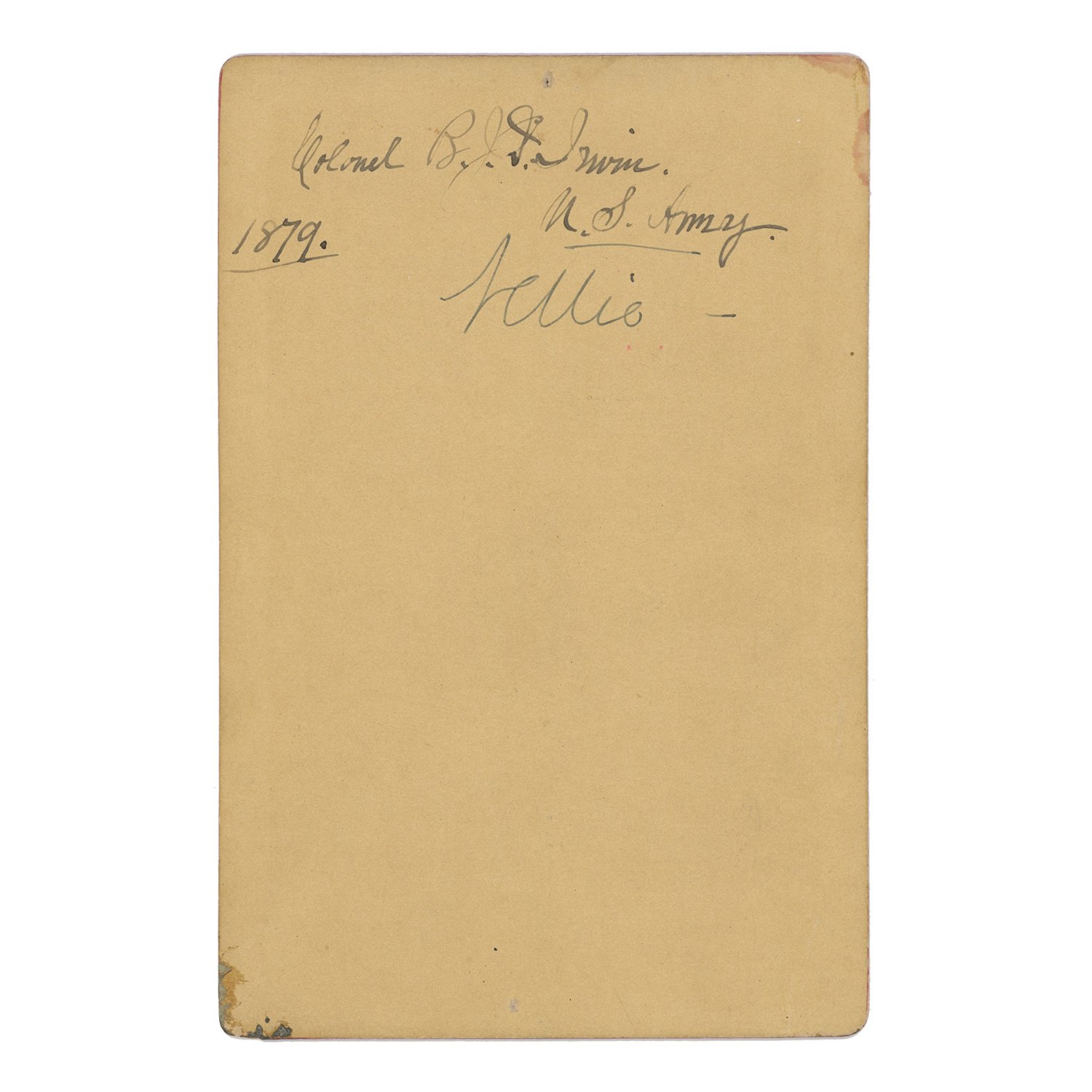
The portrait’s mount bears the imprint of F. Guidi & Pacini of Florence, Italy. Irwin spent a year in Europe after the conclusion of his service at West Point. On the reverse Irwin has signed in ink, “Colonel B. J. D. Irwin / U.S. Army / 1879.” Minor discoloration to the edge of the mount. Measures about 4 1/4” x 6 1/2”.
Quisque iaculis facilisis lacinia. Mauris euismod pellentesque tellus sit amet mollis.