
1864 Letter by Lieut. Commander Kidder R. Breese, Commanding U.S.S. Black Hawk in Red River Campaign — Battle of Pleasant Hill — Wreck of the Hospital Ship Woodford
1864 Letter by Lieut. Commander Kidder R. Breese, Commanding U.S.S. Black Hawk in Red River Campaign — Battle of Pleasant Hill — Wreck of the Hospital Ship Woodford
Item No. 5594192
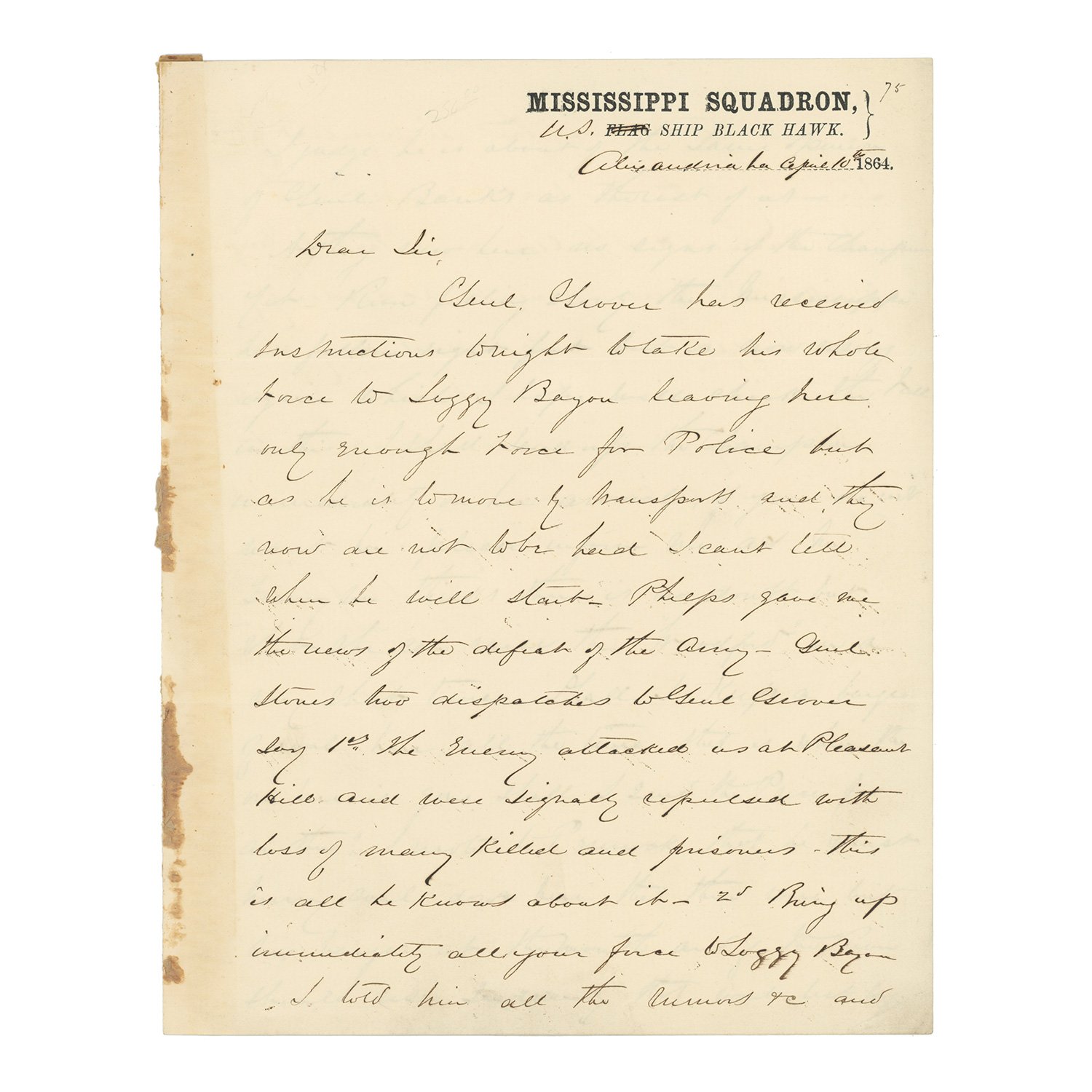
A letter from Lieut. Commander Kidder R. Breese, commander of the gunboat U.S.S. Black Hawk, written from Alexandria, Louisiana, on April 10, 1864, during the Red River Campaign. In the letter, Breese discusses troop movements, updates on the battle at Pleasant Hill, and reports on the logistical challenges of coordinating naval vessels during the difficult campaign. It was written on a letter sheet bearing the letterhead of the Black Hawk, which served as flagship of Admiral David D. Porter’s Mississippi River Squadron.
The letter begins with Breese reporting that General Cuvier Grover, a division commander in General Nathaniel P. Banks’s Army of the Gulf, had received orders to move his division up the Red River to Loggy Bayou:
Genl. Grover has received instructions tonight to take his whole force to Loggy Bayou, leaving here only enough force for Police. But as he is to move by transports and they now are not to be had, I can’t tell when we will start.
He goes on to relay news regarding the recent engagement at Pleasant Hill, where on April 9, Banks’s troops had repelled a determined attack by confederates under Major General Richard Taylor. Having already taken a licking April 8 at the Battle of Mansfield, the Pleasant Hill victory precipitated Banks’s withdrawal back down the Red River. Breese writes that Lieut. Commander Seth Ledyard Phelps, commander of the USS Eastport, “gave me the news of the defeat of the Army.” He adds that a pair of dispatches from Banks’s chief-of-staff, General Charles P. Stone, “to Genl. Grover say 1st, the enemy attacked us at Pleasant Hill and were signally repulsed with loss of many killed and prisoners. This is all he knows about it. 2d, Bring up immediately all your force to Loggy Bayou.” Evidently dismayed at the result of the campaign, he adds that he and General Grover are “about of the same opinion of Genl. Banks as the rest of us.”
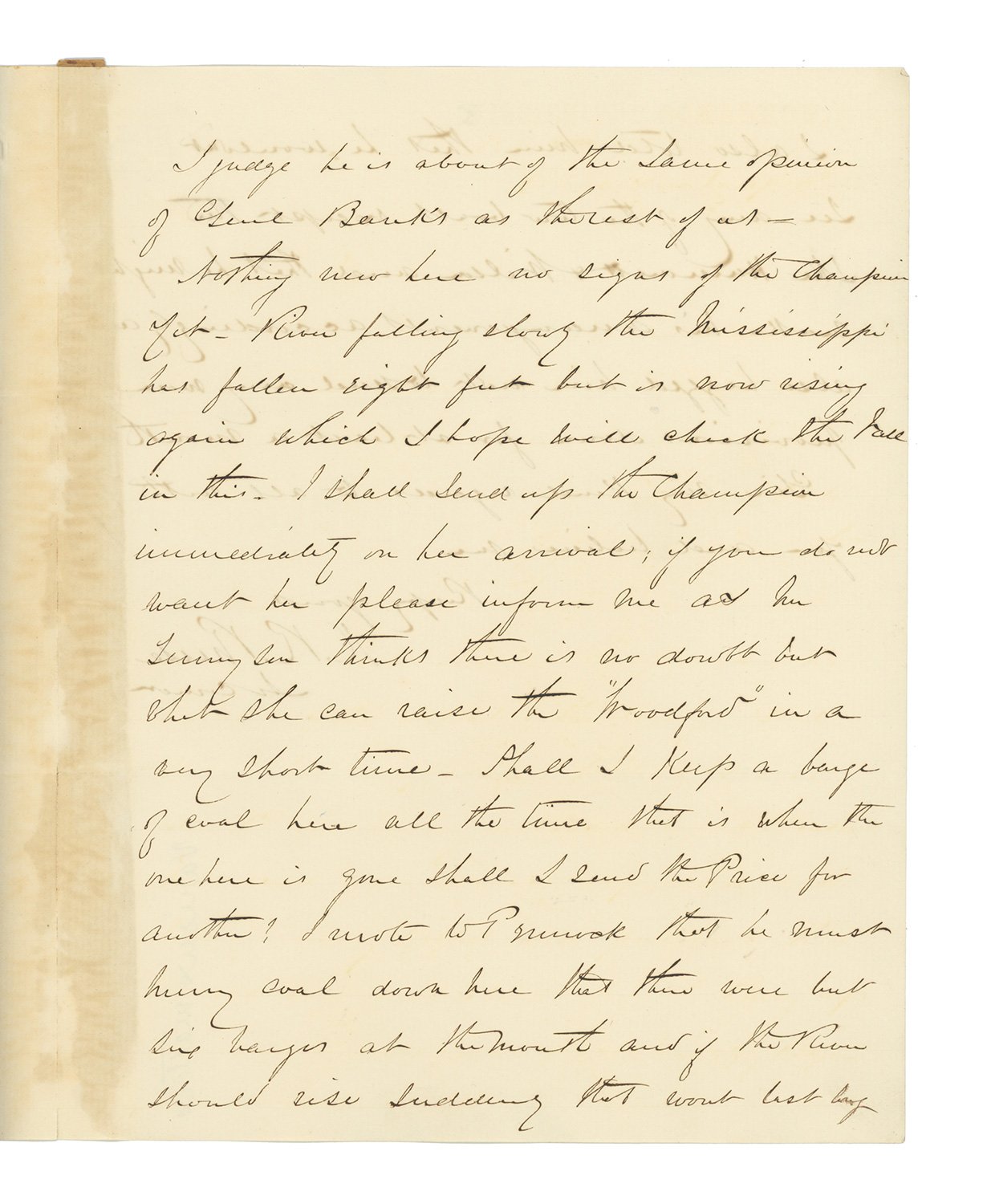
Breese then turns his attention to naval operations, stating first that the gunboat Champion had not yet arrived at Alexandria. He notes that the Red River “is falling slowly” and that “the Mississippi has fallen eight feet,” which he hopes would check the drop in the Red River. He continues, “I shall send up the Champion immediately on her arrival. If you do not want her, please inform me as Mr. Tennyson thinks there is no doubt but that she can raise the ‘Woodford’ in a very short time.” The Woodford was the hospital ship of the Mississippi Marine Brigade, which sank in the river after striking rocky falls.
He then discusses the critical need for coal and the difficulty of withdrawing Porter’s fleet down the river with such low water levels:
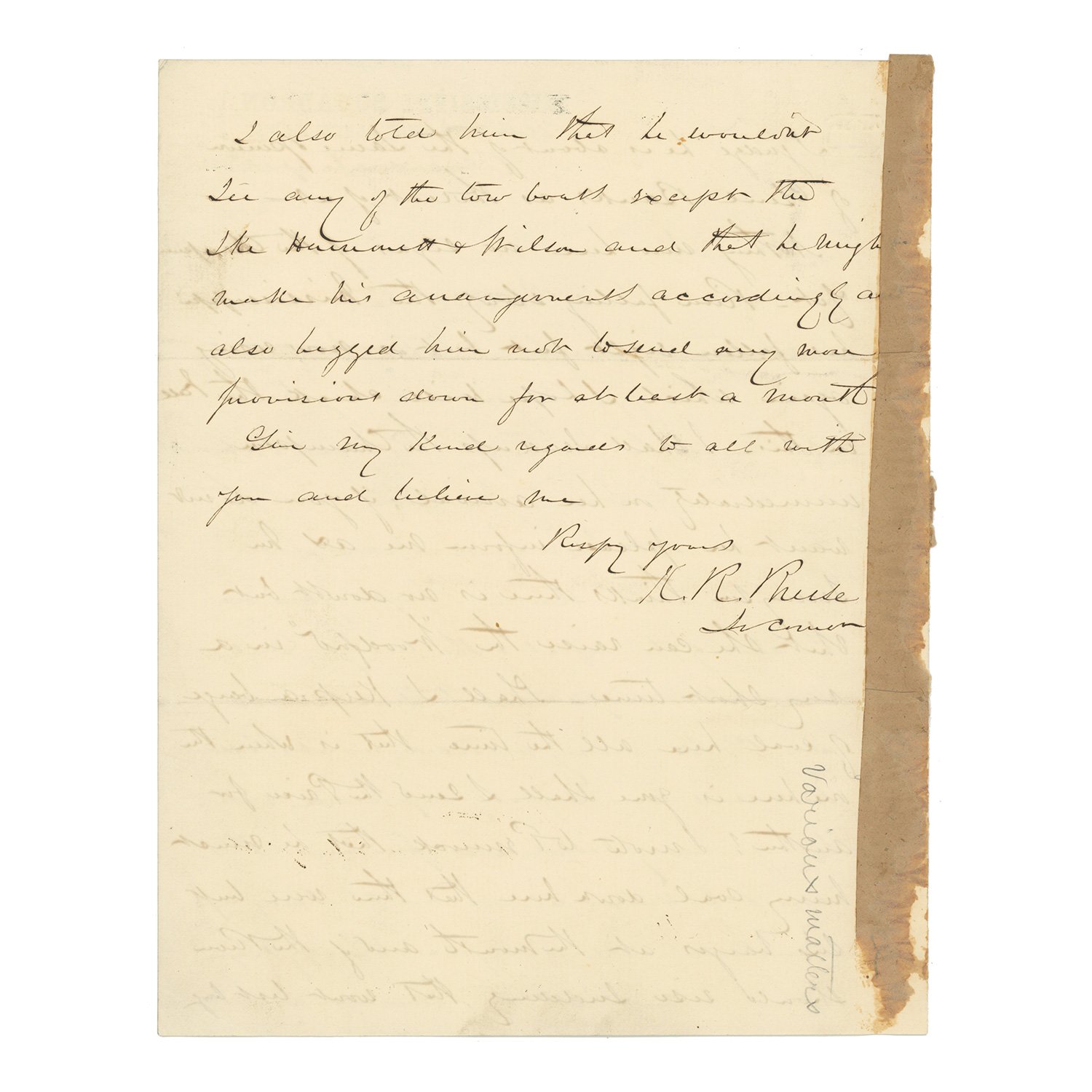
Shall I keep a barge of coal here all the time—that is, when the one here is gone shall I send the Price for another? I wrote to Pennock that he must hurry coal down here, that there were but six barges at the mouth, and if the River should rise suddenly that won’t last long. I also told him that he wouldn’t see any of the tow boats except the Ike Hammett & Wilson and that he might make his arrangements accordingly, and also begged him not to send any more provisions down for at least a month.
Kidder R. Breese had a distinguished naval career spanning the Mexican‑American War, Matthew Perry’s expedition to Japan, the Civil War, and beyond. He later served again under Admiral Porter at the Battle of Fort Fisher, where he commanded a landing force of two thousand marines and sailors.
The letter was written on three pages of a four-page bifolium letter sheet measuring about 7 3/4” x 9 3/4”. There is some residue in the margins from the letter having been previously mounted in an album. Light toning. Creased at the original folds. The full transcript appears below.
Mississippi Squadron,
U.S. Ship Black Hawk.
Alexandria La. April 10th 1864
Dear Sir
Genl. Grover has received instructions tonight to take his whole force to Loggy Bayou, leaving here only enough force for Police. But as he is to move by transports and they now are not to be had, I can’t tell when we will start. Phelps gave me the news of the defeat of the Army. Genl. Stone’s two dispatches to Genl. Grover say 1st, the enemy attacked us at Pleasant Hill and were signally repulsed with loss of many killed and prisoners. This is all he knows about it. 2d, Bring up immediately all your force to Loggy Bayou.
I told him all the rumors, &c., and I judge he is about of the same opinion of Genl. Banks as the rest of us.
Nothing new here. No signs of the Champion yet. River falling slowly. The Mississippi has fallen eight feet, but is now rising again, which I hope will check the fall in this. I shall send up the Champion immediately on her arrival. If you do not want her, please inform me as Mr. Tennyson thinks there is no doubt but that she can raise the “Woodford” in a very short time. Shall I keep a barge of coal here all the time—that is, when the one here is gone shall I send the Price for another? I wrote to Pennock that he must hurry coal down here, that there were but six barges at the mouth, and if the River should rise suddenly that won’t last long. I also told him that he wouldn’t see any of the tow boats except the Ike Hammett & Wilson and that he might make his arrangements accordingly, and also begged him not to send any more provisions down for at least a month.
Give my kind regards to all with you and believe me
Respy yours
K. R. Breese