
1869 Navy Order Transferring Engineer D. P. McCartney to Steamer "Frolic" — Signed by Admiral James Alden, Admiral Silas H. Stringham, & Commander Henry Wilson
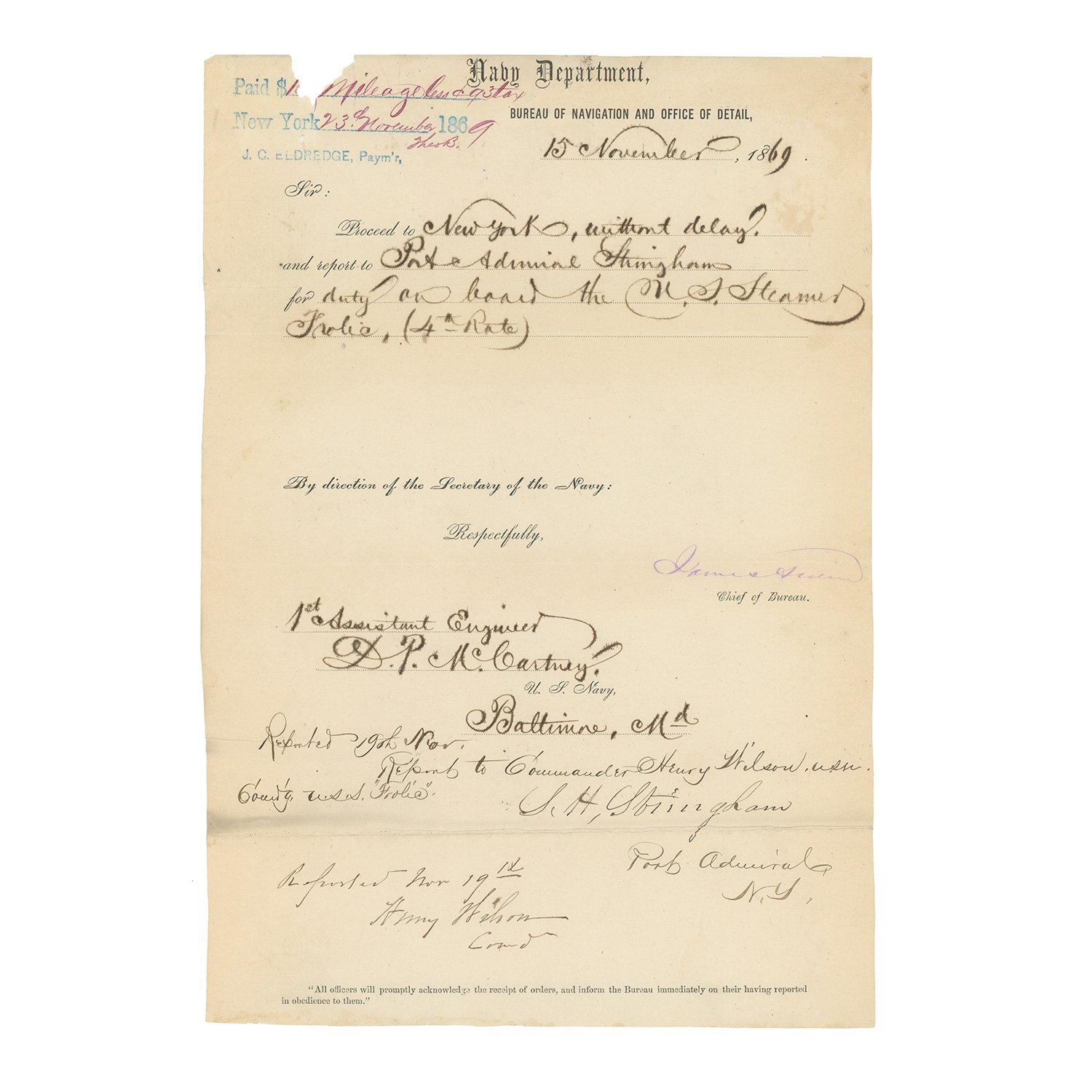
1869 Navy Order Transferring Engineer D. P. McCartney to Steamer "Frolic" — Signed by Admiral James Alden, Admiral Silas H. Stringham, & Commander Henry Wilson
Item No. 6966925
Official Navy Department order dated November 15, 1869, directing First Assistant Engineer D. P. McCartney to proceed to New York without delay and report to Admiral Silas H. Stringham for duty aboard the U.S. steamer Frolic. Signed by Admiral James Alden, Chief of the Bureau of Navigation. Alden entered the Navy in 1828 and accompanied Charles Wilkes's Expedition around the world in 1838-1842. He served in the Mexican War and, during the Civil War, commanded vessels involved in the capture of New Orleans, the Battle of Mobile Bay, and the Union assaults on Fort Fisher. In April 1869, he became Chief of the Bureau of Navigation, the office from which he issued this order. He was promoted to rear admiral in 1871 and later commanded the European Squadron.
An endorsement dated November 19 and signed by Silas H. Stringham directs McCartney to “Report to Commander Henry Wilson, U.S.N. Comd’g U.S.S. ‘Frolic.’” Stringham entered the Navy in 1809, at the age of eleven, and served in the War of 1812 and the Mexican War. At the beginning of the Civil War, he commanded the Atlantic Blockading Squadron and led the naval force that captured Forts Clark and Hatteras in North Carolina in August 1861. He subsequently served as commandant of the Boston Navy Yard and as port admiral in New York.
A second endorsement dated November 19 indicates that McCartney had reported, signed by Commander Henry Wilson, who entered the Navy as a midshipman in 1853 and served in the Gulf of Mexico during the Civil War, commanding the gunboat Owasco and later the Cayuga. He was court-martialed after the Navy's defeat at Galveston in January 1863 but acquitted. Promoted to commander in 1867, he later commanded the Frolic, including service in the early 1870s.
Frolic was an 880-ton side-wheel steamer built in Scotland as the merchant vessel Lord Clyde. Captured while attempting to run the Union blockade in September 1864, she was purchased by the U.S. Navy and served with the North Atlantic Blockading Squadron, participating in both Union assaults on Fort Fisher in late 1864 and early 1865. Renamed Frolic in June 1865, she subsequently served with the European Squadron before returning to New York in 1869. Classified as a fourth-rate steamer, she was back in commission when this order was issued in November 1869.
The document is on official Navy Department letterhead and measures about 8” x 11 1/2”. There is some slight paper loss along the top edge. Creased where originally folded.
Quisque iaculis facilisis lacinia. Mauris euismod pellentesque tellus sit amet mollis.