
1852 Letter by New York Asst. Commissary Gen. J. H. Hobart Ward, Discussing the Change from "U.S." Belt Plate to "S.N.Y." Design for State Militia Units — Ward Would Lead a Brigade at Gettysburg
1852 Letter by New York Asst. Commissary Gen. J. H. Hobart Ward, Discussing the Change from "U.S." Belt Plate to "S.N.Y." Design for State Militia Units — Ward Would Lead a Brigade at Gettysburg
Item No. 2541491
A rare, early-dated autograph letter signed (twice) by John Henry Hobart Ward, written in his capacity as the assistant commissary general for New York, nearly a decade before the outbreak of the Civil War. An 1842 enlistee in the US Army, Ward would go on to command a brigade in the Union’s Army of the Potomac, fighting with distinction at First Bull Run, Williamsburg, and Fredericksburg. At the Battle of Gettysburg in 1863, his brigade held ground in the infamous Devil’s Den and the Wheatfield. A veteran of the Mexican War and a politically active figure in New York’s military establishment, Ward’s pre-war service—as reflected in this document—offers insight into the organizational groundwork laid prior to the cataclysm of the 1860s.
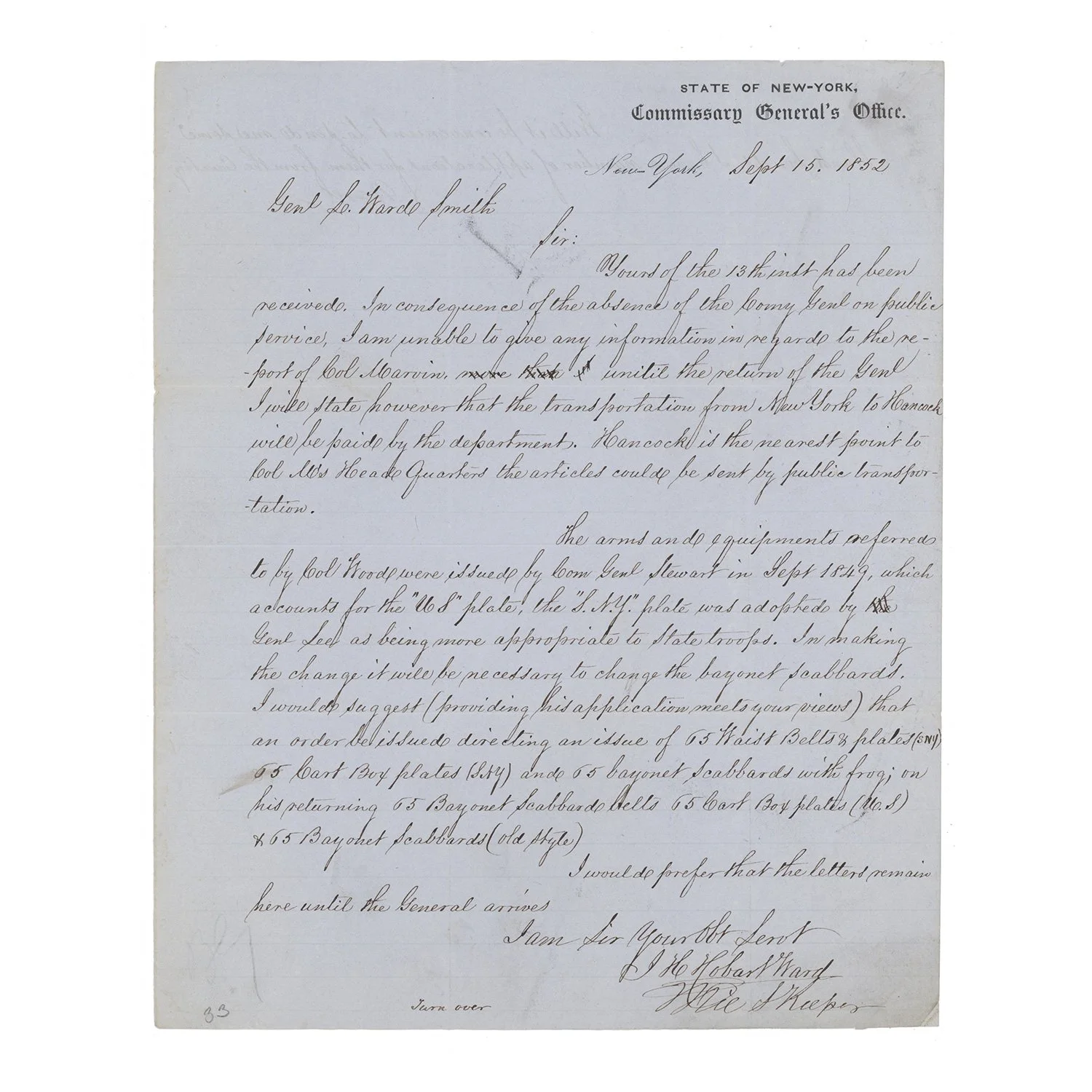
Dated September 15, 1852, this one-page letter is addressed to New York Adjutant General L. Ward Smith, concerning logistical and administrative matters tied to arms and accoutrement distribution. Ward provides detailed commentary on the issuance of military equipment and the shift from “U.S.” belt and cartridge box plates to the state’s “S.N.Y.” design, noting the need to exchange the older equipment accordingly.
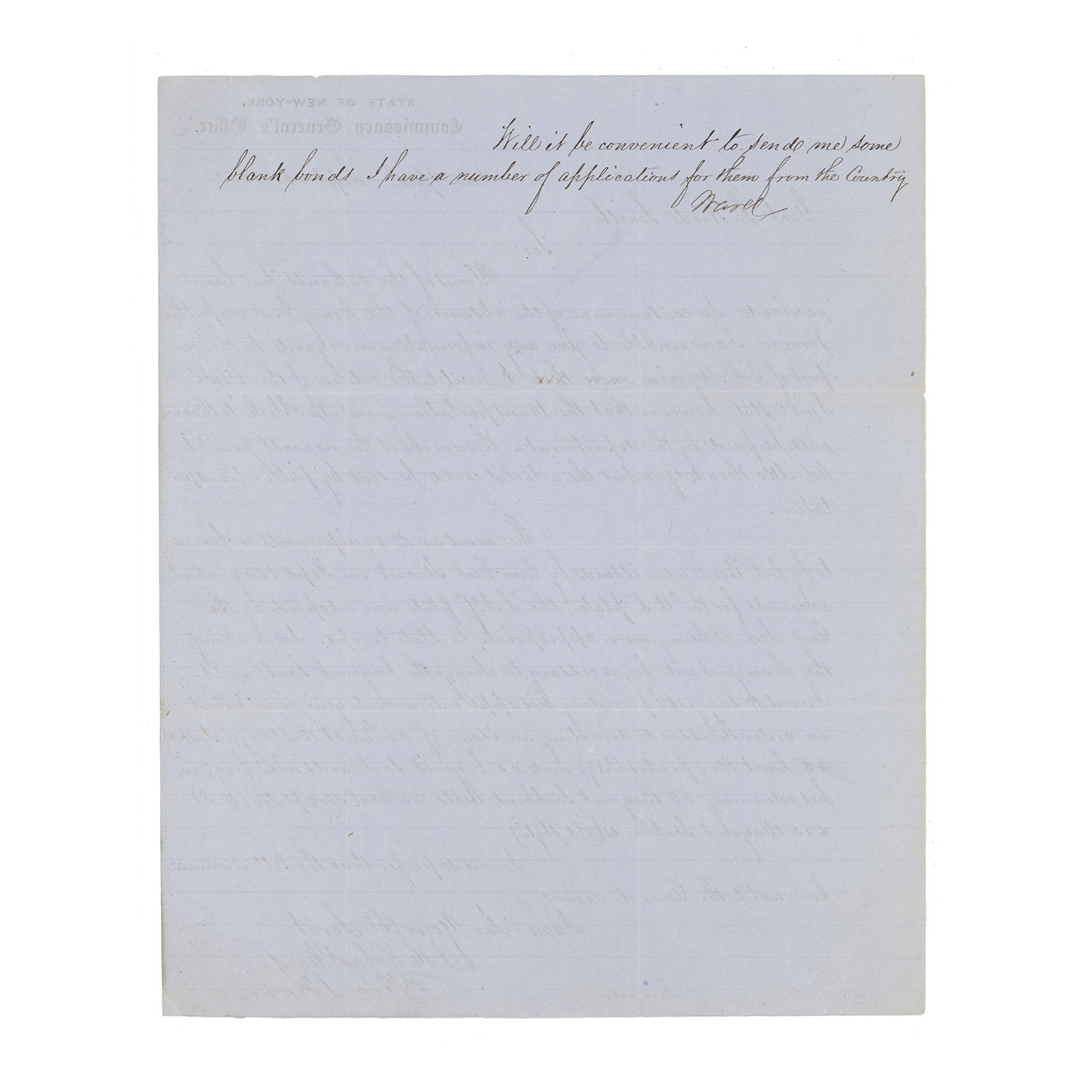
Ward signs, “J H Hobart Ward” at the bottom of the page. In brief postscript on the reverse, he requests “some blank bonds” so he could respond to “a number of applications for them from the Country.” Here he signs more familiarly, “Ward.”
J. H. Hobart Ward would rise to prominence during the Civil War, commanding a brigade at Gettysburg, where his unit held ground in the infamous Devil’s Den and the Wheatfield. A veteran of the Mexican War and a politically active figure in New York’s military establishment, Ward’s pre-war service—as reflected in this document—offers insight into the organizational groundwork laid prior to the cataclysm of the 1860s.
The letter was written on a single sheet of blue paper, 7 3/4” x 9 3/4”, bearing the letterhead of the New York Commissary General’s Office. Light toning. Creased at the original folds. The full transcript follows.
State of New York
Commissary General’s Office
New York, Sept 15, 1852
Genl L. Ward Smith
Sir:
Yours of the 13th inst. has been received. In consequence of the absence of the Comy. Genl. on public service, I am unable to give any information in regard to the report of Col. Marvin until the return of the Genl. I will state however that the transportation from New York to Hancock will be paid by the department. Hancock is the nearest point to Col. M’s Head Quarters. The articles could be sent by public transportation.
The arms and equipment referred to by Col. Wood were issued by Com. Genl. Stewart in Sept. 1849, which accounts for the “US” plate. The “S.N.Y.” plate was adopted by Genl. Lee as being more appropriate to State troops. In making the change, it will be necessary to change the bayonet scabbards. I would suggest (providing his application meets your views) that an order be issued directing an issue of 65 Waist Belts & plates (SNY), 65 Cart. Box plates (SNY), and 65 bayonet scabbards with frog; on his returning 65 Bayonet Scabbard belts, 65 Cart. Box plates (U.S.), & 65 Bayonet Scabbards (old style).
I would prefer that the letters remain here until the General arrives.
I am Sir Your Obt Servt
J H Hobart Ward
Will it be convenient to send me some blank bonds? I have a number of applications for them from the Country.
Ward
Quisque iaculis facilisis lacinia. Mauris euismod pellentesque tellus sit amet mollis.